
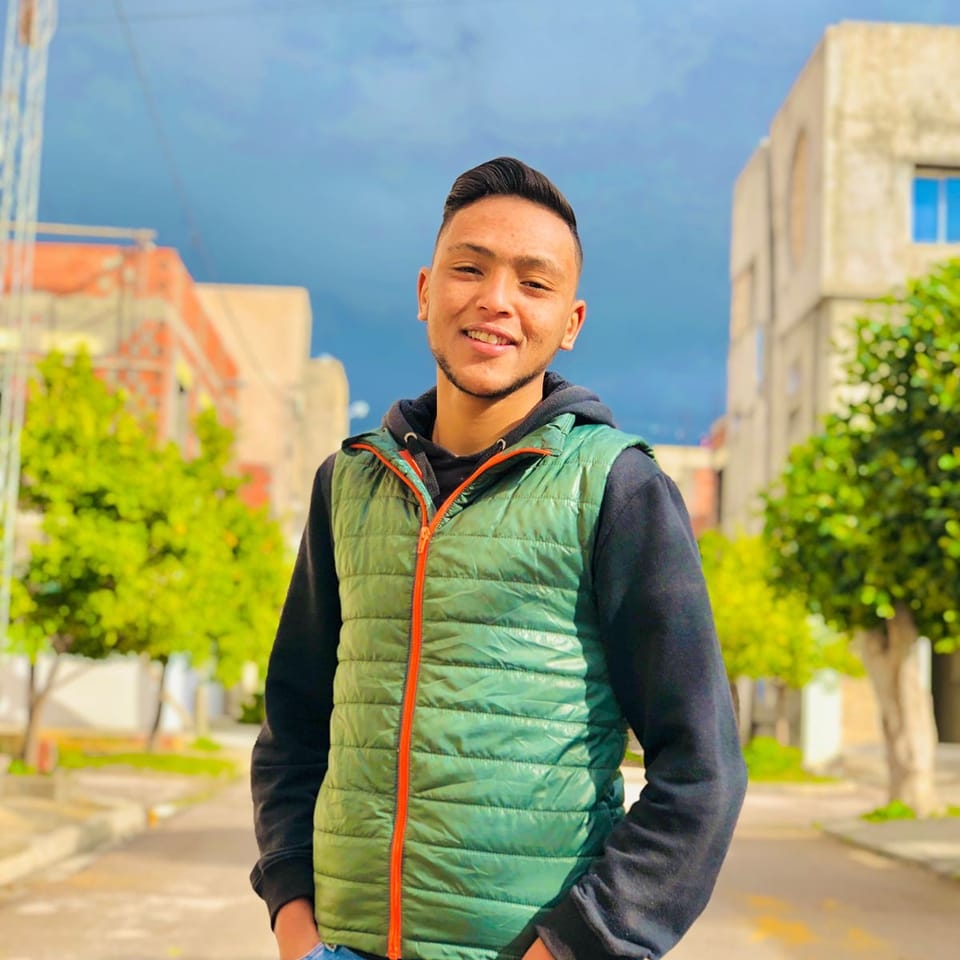
حازم عمارة – Hazem Amara
حازم عمارة - Hazem Amara
Summary
Hazem Amara, a 24-year-old resident of the Grombalia Delegation, had lived with diabetes since childhood and had undergone five open-heart surgeries. He was arrested and detained in Belli prison following a dispute with a customer at the cafe where he worked as a waiter. Despite his mother’s repeated pleas concerning his critical health condition, Hazem died approximately three weeks later as a result of medical neglect and mistreatment.
Personal Information
Name: Hazem Amara
Nationality: Tunisian
Details of the Violation
On 12 June 2025, Hazem Amara was arrested after an altercation with a customer at the café where he worked as a waiter. The arrest followed a complaint filed by the customer at the Grombalia police station. That same afternoon, Hazem was interrogated without a lawyer present.
He was held overnight at the detention centre in Nabeul Governorate. On 13 June, a detention order was issued, and he was transferred to Belli Prison on charges of premeditated murder.
On 19 June, Hazem’s mother visited him in prison and submitted his medical records to the prison authorities. The documents confirmed that Hazem held a disability card and suffered from a chronic illness that caused acute episodes requiring daily medication. Despite this, prison staff refused to let her bring in the medicines he needed.
In her testimony, Hazem’s mother recounted her final visit on 7 July 2025. Her son described the difficult conditions he was living under. He didn’t have a bed, access to the toilet was extremely limited and required long waits, and his health was deteriorating rapidly. She also noticed visible swelling under his eyes.
Hazem’s condition continued to decline. It was not until 8 July that he was transferred to Mohamed Tahar Maamouri Hospital in Nabeul. His mother stated that from the moment of his arrest, she had been asking authorities to allow him proper medical care, including visits to his regular doctor at Rabta Hospital and uninterrupted access to his prescribed medication.
One day after his admission to the hospital, a family member was contacted and told Hazem was experiencing a medical emergency and had asked to see his mother. When Mrs. Hayet arrived, it was not a doctor or official who informed her, but another patient in the hospital who told her her son had died after vomiting repeatedly for a long period without receiving any medical attention.
That same evening, at 8:00 PM on 9 July 2025, the Grombalia authorities officially notified her of Hazem’s death. The family received his body the next day after completing the required legal and administrative procedures.
Human Rights Violations
Hazem Amara’s arrest and the way he was treated in custody reflect a disturbing pattern of human rights violations that cut deeply into the core of human dignity.
From the outset, his rights were denied. He was interrogated without legal counsel, in breach of his right to a fair trial, a right protected under Article 14 of the International Covenant on Civil and Political Rights, Article 7 of the African Charter on Human and Peoples’ Rights, and Article 33 of Tunisia’s 2022 Constitution, which guarantees legal representation at all stages of proceedings. Tunisian domestic law also requires that a lawyer be present during the initial investigation.
The violations did not stop there. Hazem was repeatedly denied his right to health. Despite his mother providing official documentation of his chronic illness and medical vulnerability, she was barred from delivering his medication. No medical assistance was offered even as his health clearly worsened. The delay in hospitalising him constitutes a serious violation of his right to healthcare, enshrined in Article 12 of the International Covenant on Economic, Social and Cultural Rights, Article 16 of the African Charter, and Article 43 of the Tunisian Constitution, which affirms that health is a right for every individual and obliges the state to provide both prevention and treatment.
The way Hazem was treated stands in stark contradiction to the United Nations Standard Minimum Rules for the Treatment of Prisoners, known as the Nelson Mandela Rules, particularly Rule 24, which states that healthcare in prisons is the responsibility of the state and must be equivalent to what is available in the community. Rule 27 further requires that any prisoner in need of specialised treatment be transferred to an outside medical facility without delay.
Hazem died in degrading and inhumane conditions. According to his mother, he was shackled by the legs in the hospital room and had visible swelling beneath his eyes, signs that raise serious concerns of possible abuse or neglect during his detention. This contravenes Article 7 of the International Covenant on Civil and Political Rights, Article 5 of the African Charter, and Article 25 of the Tunisian Constitution, all of which prohibit torture and cruel, inhuman, or degrading treatment.
Moreover, the authorities’ delay in informing Hazem’s mother of his death, which occurred in the morning and was only communicated in the evening, violated her right to prompt notification. This lack of transparency is inconsistent with international standards, including the UN Basic Principles on the Use of Force and Firearms by Law Enforcement Officials, and undermines the right to know the truth.
The repeated and escalating nature of the violations Hazem endured points to serious systemic failures that may amount to criminal negligence leading to death. His case calls for an independent, impartial, and transparent investigation, not only to secure justice for Hazem and his family but also to challenge the growing culture of impunity. This is in line with Article 2, paragraph 2 of the International Covenant on Civil and Political Rights, which obliges states to ensure effective remedies for victims of rights violations and to enforce those remedies through competent judicial authorities.
Hazem’s death is not an isolated incident. It is part of a broader and deeply troubling pattern of human rights abuses and official impunity that has claimed the lives of many young Tunisians under suspicious circumstances, without accountability, without answers, and without justice.