
Summary:
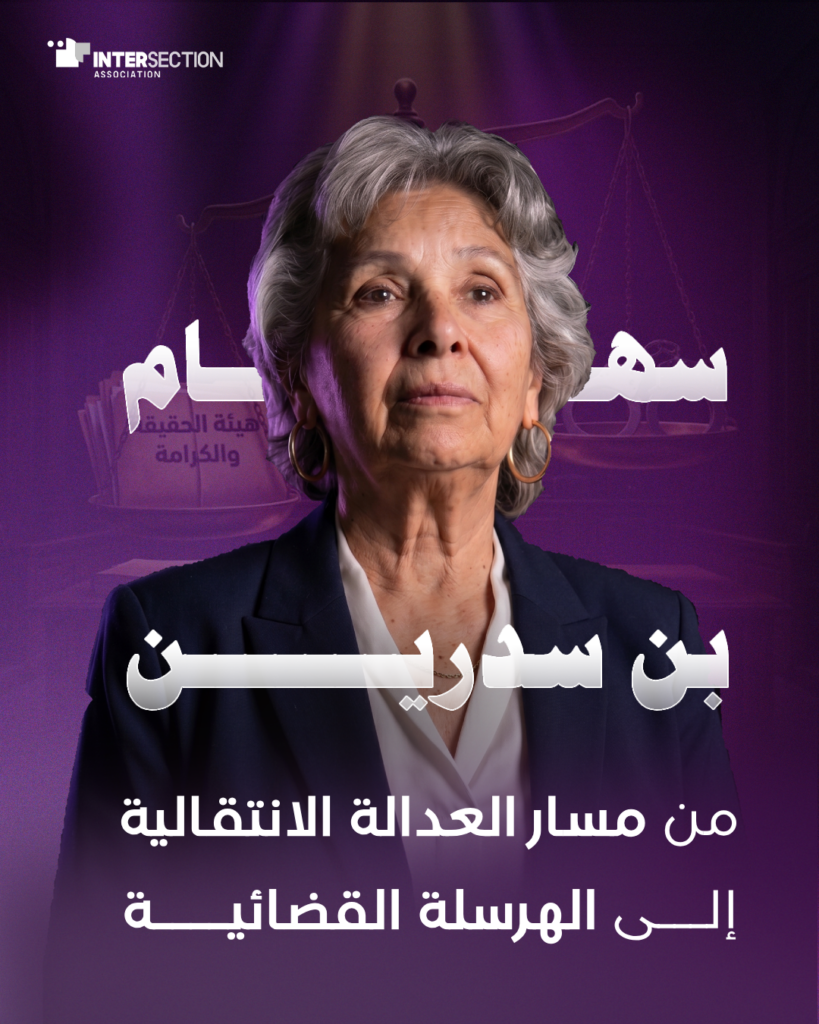
Sihem Bensedrine, a human rights activist and previous president of the Truth and Dignity Commission, has been subjected since 2021 to a series of judicial proceedings.
This began with numerous summons for questioning as a witness, before shifting in February 2023 into criminal prosecutions across six cases related to corruption and the alleged falsification of the Commission’s final report. The restrictive measures taken against her include a travel ban, house arrest, and prolonged interrogation, leading to her detention order against her. She was later released in February 2025, while trials continue and hearings have been postponed into 2026.
Personal Information:
Name: Sihem Bensedrine
Age: 76 years
Occupation: Previous president of the Truth and Dignity Commission
Nationality: Tunisian
Region: Tunis
Charges:
– Three charges related to violations in handling 3 arbitration cases.
– One charge related to the mismanagement of the archives of the Truth and Dignity Commission.
– One charge related to the mismanagement of the Commission’s administrative and financial affairs.
-One charge related to the alleged falsification of the Commission’s final report.
And that’s based on Articles 82, 83, 84, 87, 91, 96, 98, 99, 172, 175, 176 and 177 of the Penal Code.
Methodology:
Intersection Association for Rights and Freedoms prepared this research paper based on a methodology built on monitoring and careful documentation. Information was collected from reliable media sources, then verified, analyzed, and organized in chronological order to ensure accuracy and a clear construction of the events.
The association also supported this work with qualitative field data, through two in-depth interviews with Sihem Bensedrine conducted on 4 and 9 December 2025, in addition to regular contact with the defense team, most recently on 15 April 2026, to update information and clarify the procedural and legal aspects of the cases under prosecution.
The paper further adopts a comparative analytical approach, presenting the facts and measures taken in light of the provisions of the 2022 Tunisian Constitution, as well as Tunisia’s international obligations, particularly those arising from the International Covenant on Civil and Political Rights and other relevant instruments related to fair trial guarantees. This approach aims to provide an objective human rights analysis, highlighting the nature of the documented violations, assessing the consistency of the practices under review with constitutional and international standards, and outlining the scope of the State’s obligations in this area.
Violation Incidents:
Since March 2021, Sihem Bensedrine has been summoned 6 times for questioning as a witness by officers of the judicial police from the Central Financial Crimes Unit of the National Guard in Aouina. Other members of the Truth and Dignity Commission were also questioned by the same unit.
On 20 February 2023, the Public Prosecutor at the Court of First Instance decided to open six investigative cases and assigned them to three investigating judges in Chambers 6, 9, and 15 of the Economic and Financial Judicial Pole. Bensedrine faces charges of corruption and falsification of the Commission’s final report, based on a complaint filed by a former member of the Commission who had herself been subject to disciplinary measures during her tenure.
The paragraph reportedly added to the final report, which was approved by the Commission’s Council, concerns the case of the Franco-Tunisian Bank (BFT), a case dating back 38 years, which the Commission had itself referred to the judiciary. In this case, 23 senior officials, along with businesspeople, are being prosecuted on charges including abuse of power, embezzlement, misuse of office, and breach of trust in the management of public funds.
The defense team has stated that the Truth and Dignity Commission’s work on the Franco-Tunisian Bank case was presented publicly during the closing conference on 14 December 2018, including a detailed timeline and documented presentation published on the Commission’s website, in the presence of all Council members, including the member who now alleges falsification. The Council also approved this paragraph of the report during its session on 27 December 2018, as recorded in the official minutes.
When adopting the various parts of the report, the Council granted itself a deadline until the end of January 2019 to make the necessary corrections. However, the comprehensive final report was approved on 30 December 2018, and the President of the Republic set an official date for its submission on 31 December 2018. The report was delivered on the scheduled date, without the possibility of carrying out the usual technical revisions, with the Presidency of the Republic being informed of this, and the process took place under the supervision of the Commission’s Council.
It is standard practice for official texts to undergo technical review prior to publication in order to correct any errors that may arise during the drafting process. These revisions were incorporated into the report submitted to the Head of Government.
The published report constitutes the legally authoritative version. By contrast, the version submitted to the President of the Republic is symbolic in nature and carries no legal effect vis-à-vis third parties. The document with legal force is the version published online on 26 March 2019 and subsequently included in the Official Gazette on 24 June 2020.
On March 2, 2023, the investigating judge at the Financial Judicial Pole, Office No. 6, issued a decision to ban Sihem Bensedrine from traveling.
She was summoned for an interrogation session that lasted more than 40 hours (over four successive days February 5, 6, 7, and 8 of 2024), during which she was heard by the investigating judge at Office No. 15, who decided to keep her released. However, the Public Prosecutor appealed the decision and requested a detention warrant against her.
On February 28, 2024, the Indictment Chamber of the Tunis Court of Appeal upheld the decision to keep her released and rejected the Public Prosecutor’s appeal.
The defense team confirmed that the investigating judge at Office No. 15, who had decided to keep her released, received a work memo two weeks later, indicating his transfer to the Court of First Instance in Jendouba without being replaced by another judge.
On March 4, 2024, the investigating judge at Office No. 6 decided to place her under house arrest until March 27, 2024, the date of her interrogation.
The defense team states that on March 27, 2024, the same judge was promoted to the position of General Prosecutor at the Tunis Court, thereby becoming head of both the Judicial Counter-Terrorism Pole and the Economic and Financial Judicial Pole.
On July 24, 2024, Bensedrine was summoned to appear on August 1, 2024, before Office No. 37 of the Financial Judicial Pole, which was temporarily in charge of Office No. 15, for questioning, which was based on Articles 82, 83, 84, 96, 98, and 99 of the Penal Code.
During the hearing session, the defense team realized that the investigating judge intended to question her in connection with the case of the “falsification of the Truth and Dignity Commission report,” even though this case falls under the jurisdiction of the investigating judge at Office No. 6. At the end of the session, he decided to issue a detention warrant against her, and she was subsequently placed in the women’s prison in Manouba.
On January 14, 2025, Sihem Bensedrine began a hunger strike in protest against her imprisonment without legal grounds, as well as the delays in investigating her case and the rejection of her request to remain free, subsequently, her health began to deteriorate significantly, which led on the evening of January 25, 2025, to her transfer to the intensive care unit at the Hospital of Rabta to receive necessary treatment. She spent eight days in intensive care and stated that she had been subjected to degrading treatment, describing what she called, according to her testimony, a “violation of the healthcare institution by security forces.” She also reported that her legs were cuffed while she was receiving treatment.
Her health condition required urgent medical intervention to stabilize her quickly, as well as specialized care from a cardiologist, according to her family, who were able to visit her after five days of isolation imposed on her inside the hospital. She later decided to suspend her hunger strike on Thursday, January 30, 2025.
On February 19, 2025, the Indictment Chamber of the Tunis Court of Appeal examined Sihem Bensedrine’s appeal against the decision of the First Investigating Judge at the Economic and Financial Judicial Pole, which had rejected her request for release in the case related to the alleged falsification of the final report of the Truth and Dignity Commission. On the same date, the Chamber decided to grant her release. Since Bensedrine was detained only in connection with this case, the decision resulted in her release, and also imposed a travel ban on her.
On November 17, 2025, Bensedrine attended a hearing at the Court of First Instance in Tunis in two cases related to the French-Tunisian Bank file and an arbitration case linked to Slim Chiboub. The hearing was postponed several times: to January 5, 2026, then February 19, March 16, April 16, and finally May 18, 2026.
Another interrogation session was scheduled for April 21, 2026, then postponed to May 26, 2026. A further session was also set for late April, concerning other cases related to the Commission’s work.
More broadly, what Sihem Bensedrine has faced goes beyond normal legal proceedings, taking the form of ongoing harassment that intensified after the Truth and Dignity Commission completed its work and published its final report in the Official Gazette. The report documented serious human rights violations and financial crimes between 1955 and 2013, and referred 205 cases involving over 1,000 officials to specialized criminal chambers, without any rulings issued to date, while those involved in the process continue to face prosecution.
And according to the defense team, this campaign is an attempt to remove the final report from the Official Gazette and hide the violations and corruption it revealed.
Human Rights Violations:
The case against Sihem Bensedrine shows a clear pattern of judicial harassment as it combines legal actions with what appears to be an attempt to weaken the importance of Tunisia’s justice process, especially the work of the Truth and Dignity Commission and its final report.
First, there are many cases brought against her at the same time, and she has been moved from being a witness to being accused in several files at once. This raises concerns about legal certainty and possible abuse of power, which goes against the Tunisian Constitution, especially Article 55, which says that limits on rights must be necessary and must not affect their core. The charges themselves, related to adding a paragraph to the final report about the Franco-Tunisian Bank case, also raise questions about political use of the law. This is particularly important since the original issue was about sending corruption cases to court to hold officials and businesspeople accountable.
Second, there are concerns about fair trial rights and judicial independence, as Bensedrine was questioned for more than 40 hours, which could be seen as cruel or inhuman treatment. This goes against the International Covenant on Civil and Political Rights (ICCPR), especially Articles 7 and 14, and also against Article 25 of the 2022 Tunisian Constitution, which protects human dignity and bans torture. In addition, the decision to detain her in a case where there is debate about which court has authority raises concerns about the right to be judged by the proper court. In her case, she was called before a judge who may not have had proper jurisdiction, which is a serious procedural problem and not just a technical issue, as everyone has the right to be judged by the correct legal authority, and ignoring this can affect the fairness of the whole process.
There are also signs of possible pressure from the executive branch on the judiciary, such as reports of judges being transferred or promoted around the time important decisions were made. This can weaken the separation of powers and reduce trust in the independence of the courts, and it goes against international standards on judicial independence.
Third, there are reported violations of her dignity and physical integrity during detention. For example, cuffing her legs while she was receiving treatment in intensive care is a serious violation of human dignity, which goes against Article 25 of the Tunisian Constitution which affirms that “the State protects human dignity and the inviolability of the human body, and prohibits all forms of moral and physical torture.” as well as the Nelson Mandela Rules, which limit the use of restraints and forbid degrading or inhuman treatment.
Overall, these elements, multiple cases, procedures, and violations, suggest that this situation is part of a wider context where fair trial guarantees and judicial independence are weakening, and where the transitional justice process itself may be under threat, raising serious concerns about Tunisia’s respect for its human rights commitments.