
Remote Trials in Tunisia The Back Door to a Dysfunctional Justice System
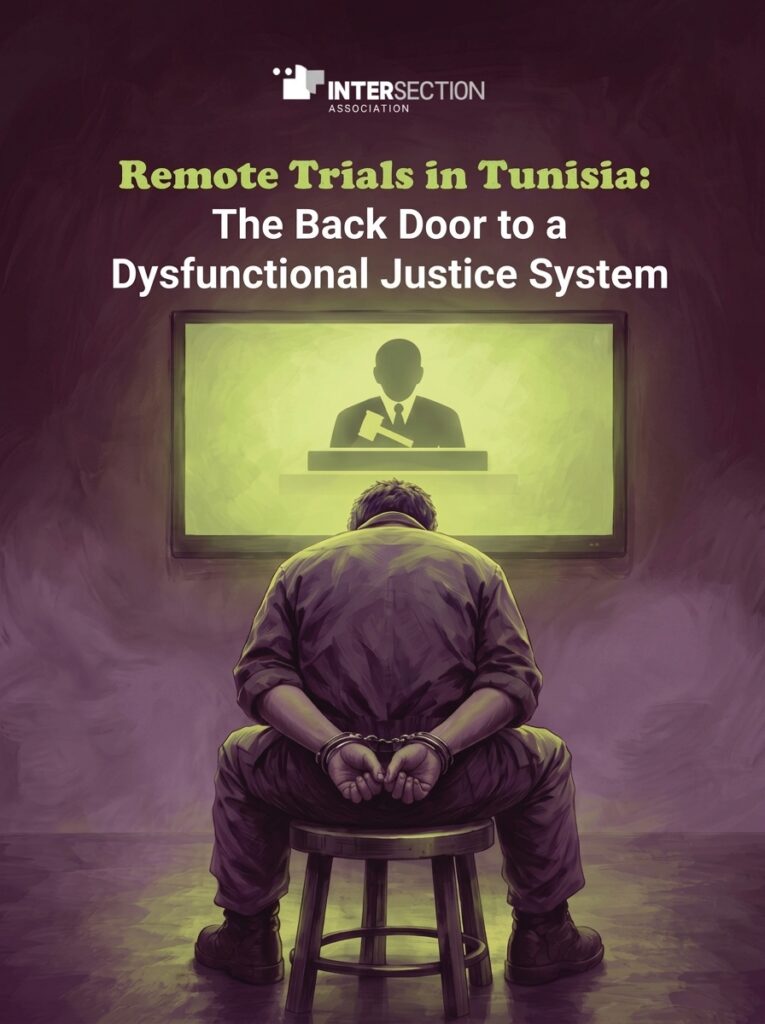
You can access the paper via this link: Remote Trials in Tunisia The Back Door to a Dysfunctional Justice System
Intersection Association for Rights and Freedoms is publishing its new research paper entitled “Remote Trials in Tunisia The Back Door to a Dysfunctional Justice System.” The paper examines the current framework governing remote criminal trials, focusing on the legal provisions regulating this procedure and their judicial application, as well as the resulting violations of fair trial guarantees enshrined in the Constitution and international human rights instruments. This comes as remote trials have evolved from a limited exception into an almost routine practice in several courts.
The paper traces the legislative developments that led to the adoption of remote trials in Tunisia, showing that they did not emerge from a comprehensive judicial reform strategy to modernise the justice system, but from a succession of temporary measures. The procedure was first introduced through remote questioning under counter-terrorism legislation, then extended during the COVID-19 pandemic, and continued to be applied even after the circumstances that had justified its introduction had ended.
The paper also examines the constitutional concerns arising from this legislative trajectory. Decree No. 12 of 2020 was issued under a legislative delegation specifically intended to address the pandemic and was never submitted to Parliament for ratification. Nevertheless, it continues to serve as a legal basis for this practice today. The paper further highlights the ambiguity surrounding the concept of “imminent danger,” which allows courts to impose remote trials without the defendant’s consent through a decision that cannot be appealed. It also points to the routine use of this exception in practice, often without sufficient reasoning, effectively reversing the relationship between the rule and the exception.
The paper documents several procedural violations associated with the implementation of remote trials, including infringements on the defendant’s right to appear in person, the right to defence and confidential communication with legal counsel, as well as the principles of adversarial proceedings and public hearings. It also highlights how technical difficulties have led to disruptions in court hearings. Particular attention is given to the February 2025 decision that imposed remote trials on 149 cases simultaneously and without a specified time limit, contrary to the legal requirement to assess each case individually.
It also examines the case commonly known as “Conspiracy Against State Security” as a revealing example of the far-reaching consequences of this procedure, particularly in light of prolonged pretrial detention, the collective nature of the charges, and the severity of the sentences. It demonstrates that defendants’ objections to being absent from the courtroom did not prevent the continued use of remote proceedings.
The research draws on a legal analysis of the legislation governing remote trials and its judicial application, interviews with lawyers from several regions, and a comparative examination of relevant case law. This comparison identifies three cumulative conditions for the legitimacy of remote trials: the defendant’s explicit consent, the protection of confidential communication between the defendant and their lawyer, and an individually reasoned judicial decision subject to judicial review. These conditions are either absent or insufficiently guaranteed in the current Tunisian practice.
The paper concludes that the issue does not lie in the digitalisation of justice itself, but rather in its implementation within an ambiguous legal framework and an inadequate infrastructure. As a result, a procedure initially presented as a means of modernising the justice system has become a tool that undermines fair trial guarantees and the effective exercise of the right to defence, particularly in cases of a political nature.
In light of its findings and analysis, Intersection Association for Rights and Freedoms stresses the need to review the legal framework governing remote trials and the way it is applied by the courts. In this regard, the Association calls for a series of recommendations, foremost among them recognising the defendant’s explicit consent as a fundamental requirement for the use of remote trials, and allowing departures from this principle only in clearly defined exceptional circumstances. It also calls for the revision of Article 141 bis of the Code of Criminal Procedure to restore in-person hearings as the rule and remote trials as the exception.
The Association further stresses the need to establish clear and objective criteria for defining “imminent danger” in order to prevent its arbitrary application, and to clearly define the conditions and safeguards governing exceptional cases. These safeguards must prevent the exception from being used to bypass the defendant’s explicit consent or to turn remote trials into routine practice. The Association also calls for decisions authorising remote trials to be subject to appeal before a competent judicial authority, for defendants’ right to appear in person during questioning to be guaranteed, and for comprehensive and regular statistics to be published on remote trials and the reasons for their use.
Intersection lastly reiterates that the digitalisation of justice must serve as an extension of fair trial guarantees, not a substitute for them.