
Twenty-Year Prison Sentence for Riadh Ben Fadhel: Another Chapter in the Ongoing Crackdown on Tunisia’s Political Space
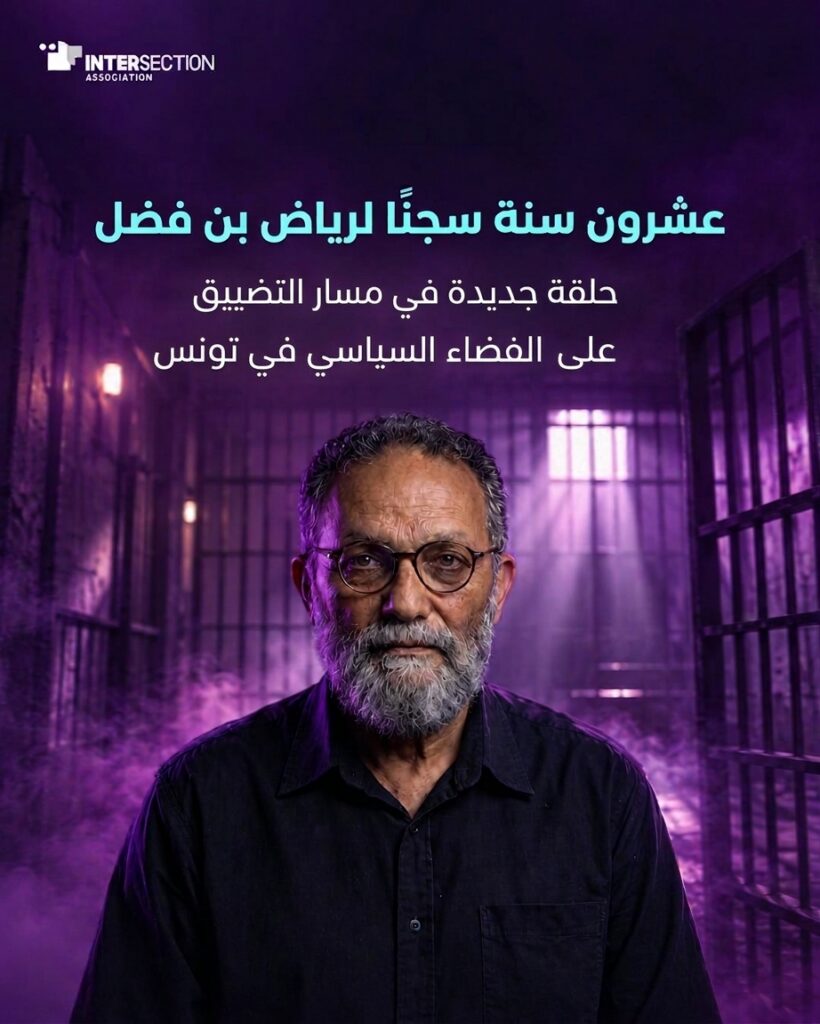
Intersection Association for Rights and Freedoms condemns the ruling issued on 29 October 2026 by the Criminal Chamber of the Tunis Court of First Instance against politician Riadh Ben Fadhel, sentencing him to twenty years in prison in connection with what is known as the confiscated assets case.
In this regard, the Association recalls that Riadh Ben Fadhel had previously benefited from a ruling ordering the discontinuation of proceedings through settlement in the customs and banking case. This calls for closer examination of the context of the successive judicial proceedings against him and their implications.
This ruling comes amid an ongoing series of prosecutions and trials targeting politicians, through the use of legislative provisions to pursue and exclude political actors from public life. This reinforces an atmosphere of pressure on the opposition, threatens the foundations of the rule of law and institutions, and undermines political, party and civil pluralism in the country.
In this context, Intersection Association for Rights and Freedoms expresses its full and unconditional solidarity with politician Riadh Ben Fadhel and his family. It also considers that the impact of a prison sentence extends beyond the individual concerned to affect their family members, who must also face the consequences of his forced absence and the resulting human and social burdens, in addition to the harsh conditions of imprisonment and their impact on family ties and everyday life.
Furthermore, Riadh Ben Fadhel’s removal from the political scene and his deprivation of the opportunity to continue his activities and play a role in public affairs risk deepening the ongoing decline of the political space, particularly amid the marginalisation and exclusion of political actors and the shrinking space for pluralism, dissent and participation in public life. This further weakens political life in the country.
The Association stresses that the continued prosecution of politicians and the issuance of prison sentences against them, in circumstances that raise serious concerns regarding fair trial guarantees, are incompatible with Tunisia’s constitutional and international obligations to protect rights and freedoms, particularly the right to liberty and security of person and the guarantees of a fair trial.
Finally, the Association for Rights and Freedoms calls on the Tunisian authorities to respect fair trial guarantees, safeguard fundamental rights and freedoms, and put an end to the use of judicial proceedings as a means of restricting political and civil actors. Intersection also warns of the risks that this continued course of action poses to the remaining gains of the Revolution and to the future of political pluralism and the civil and human rights space in Tunisia.