
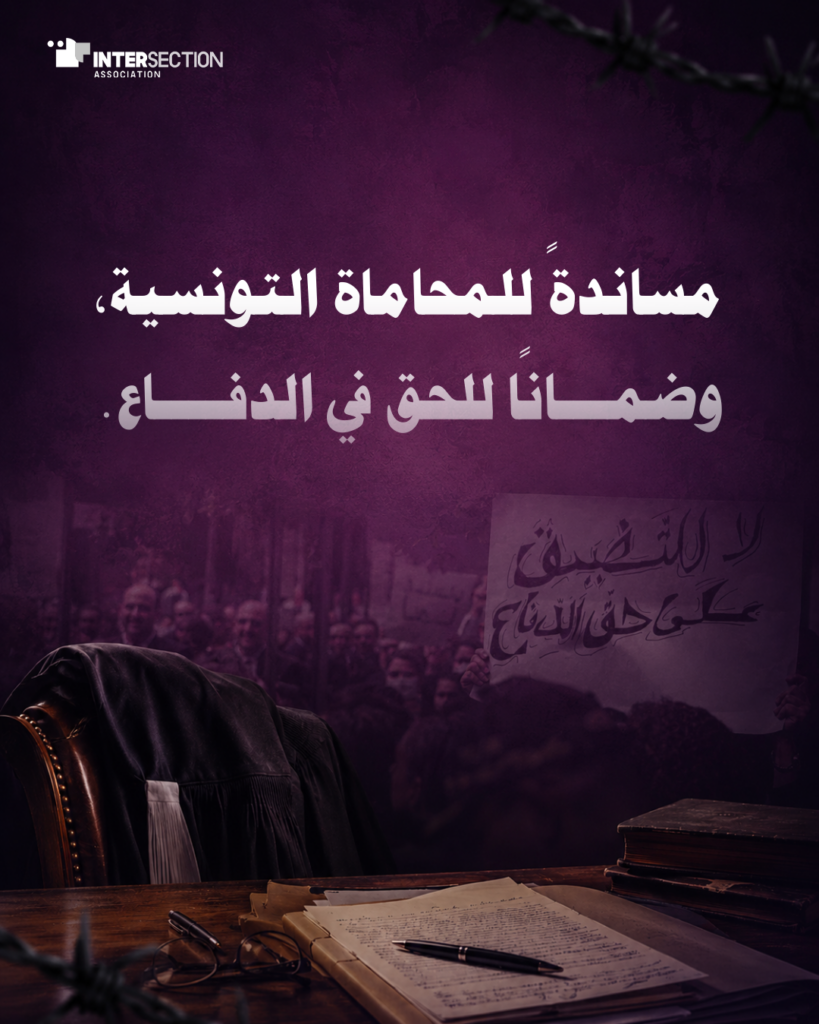
Intersection Association for Rights and Freedoms is closely following the peaceful protest organised by the Tunisian Order of Lawyers on 18 June 2026, following the breakdown of dialogue with the public authorities over a set of professional demands with direct implications for rights and justice. These demands relate to reforming the social protection system for lawyers, improving the conditions in which the profession is practised, and ensuring the effective exercise of the right to defence before the courts.
The Association notes that this protest follows a series of correspondence and initiatives launched since January 2026, which have not led to a serious and responsible dialogue with the authorities concerned. It considers that the continued disregard of these demands affects not only the rights of lawyers, but also the proper functioning of the justice system, fair trial guarantees, and the right of litigants to an effective defence and to a judicial system capable of protecting rights and freedoms.
The Association affirms that protecting the independence of the legal profession and safeguarding the conditions necessary for its practice are essential pillars of the rule of law, in line with relevant national and international standards. Article 41 of the Tunisian Constitution guarantees trade union rights and the right to strike, while Article 124 enshrines the right of access to justice and the right to a fair trial. Article 14 of the International Covenant on Civil and Political Rights also guarantees the right of every person to defend themselves through counsel of their own choosing.
The Association considers that ensuring the necessary conditions for lawyers to carry out their work is essential to protecting these rights and guaranteeing their effective enjoyment. It also recalls that the UN Basic Principles on the Role of Lawyers, adopted in 1990, require that lawyers be able to perform their professional duties freely and independently, without pressure, interference, or unlawful restrictions.
The Association further considers that the demands raised by the Tunisian Order of Lawyers go beyond their immediate professional dimension. They are directly linked to fundamental guarantees for the protection of rights and freedoms and to strengthening access to justice. Any weakening of the conditions in which lawyers practise their profession, or any interference with its independence, directly affects litigants’ ability to enjoy their rights and exercise their right to defence.
Accordingly, Intersection Association for Rights and Freedoms expresses its full solidarity with lawyers in their peaceful protest. It calls on the public authorities, foremost among them the Ministry of Justice, to open a serious and responsible dialogue with the Tunisian Order of Lawyers and to respond to legitimate demands that would strengthen the independence of the profession and improve the conditions in which it is practised, while ensuring the continuity of the justice system and the protection of litigants’ rights.
The Association reiterates that respecting the independence of the legal profession and supporting its professional and social foundations is not a narrow sectoral demand. Rather, it is an integral part of protecting the right to defence and building an independent and effective justice system that guarantees rights and freedoms for all citizens, strengthens trust in judicial institutions, and upholds the rule of law.