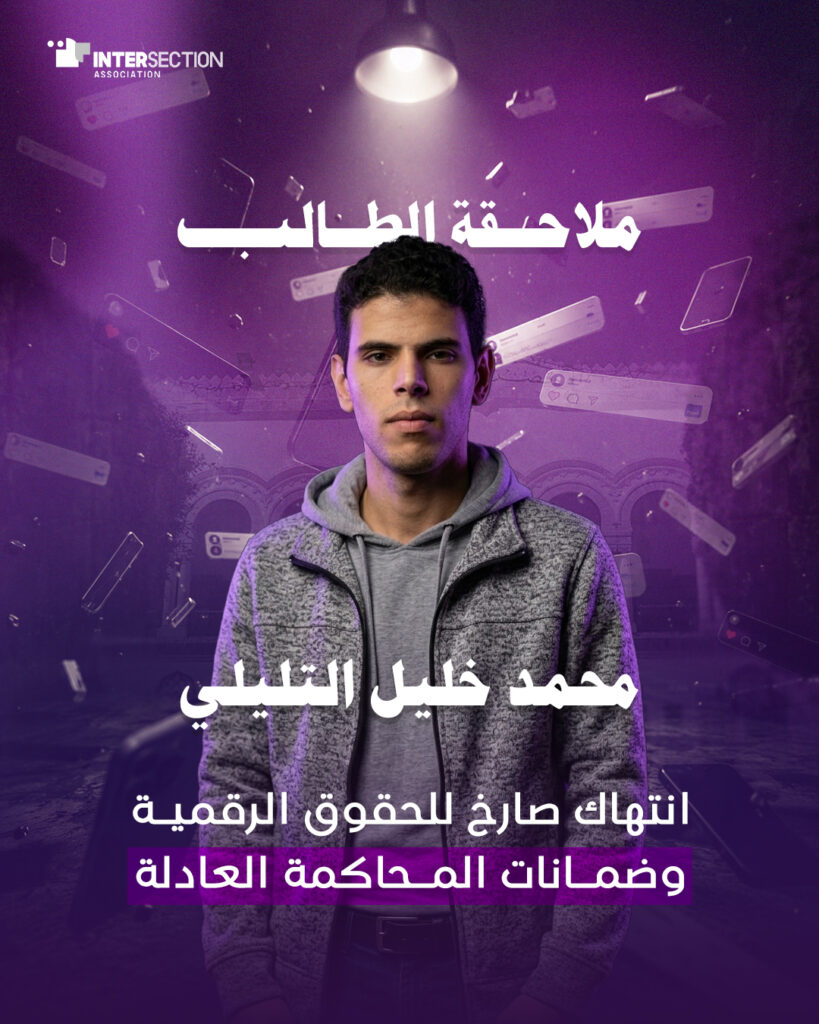
On Wednesday, 10 June 2026, student Mohamed Khalil Tlili appeared before the Court of First Instance in Tunis to challenge a first-instance judgment issued in absentia, sentencing him to one year in prison on terrorism-related charges under the Counter-Terrorism Law. The charges were brought against him on the basis of digital content found on his mobile phone, which was searched without prior judicial authorization or any legally justified suspicion.
Mohamed Khalil Tlili was arrested on 21 August 2025 after digital content was found on his phone and online accounts, following a search of his phone by plainclothes security officers. After a period of inquiries and investigations, during which he remained at liberty and complied with all judicial summonses, he was informed on 1 June 2026 that a judgment had been issued against him in absentia, sentencing him to one year in prison. He was subsequently arrested and transferred to Mornaguia Civil Prison. His defence team filed an objection to the judgment, and he remains in detention pending the court’s examination of the objection.
In this context, Intersection Association for Rights and Freedoms condemns the serious violations of fair trial guarantees that have marked the case of student Mohamed Khalil Tlili, from the moment of his arrest to his imprisonment for the enforcement of the judgment issued against him, without him, his family, or his defence team being informed of the progress or outcome of the case.
The Association also denounces the recurrence of this systematic pattern of judicial prosecution, which poses a direct threat to individual freedoms, particularly freedom of belief, freedom of opinion and expression, and the right to publish content on social media platforms.
Accordingly, Intersection Association for Rights and Freedoms stresses the need to uphold fair trial guarantees enshrined in national and international law, in order to protect individuals’ rights and safeguard their digital freedoms, including the rights to expression and access to information.
The Association further emphasizes that the exercise of these fundamental freedoms must not be used as a pretext to further deprive citizens of their liberty or send them to prison..