
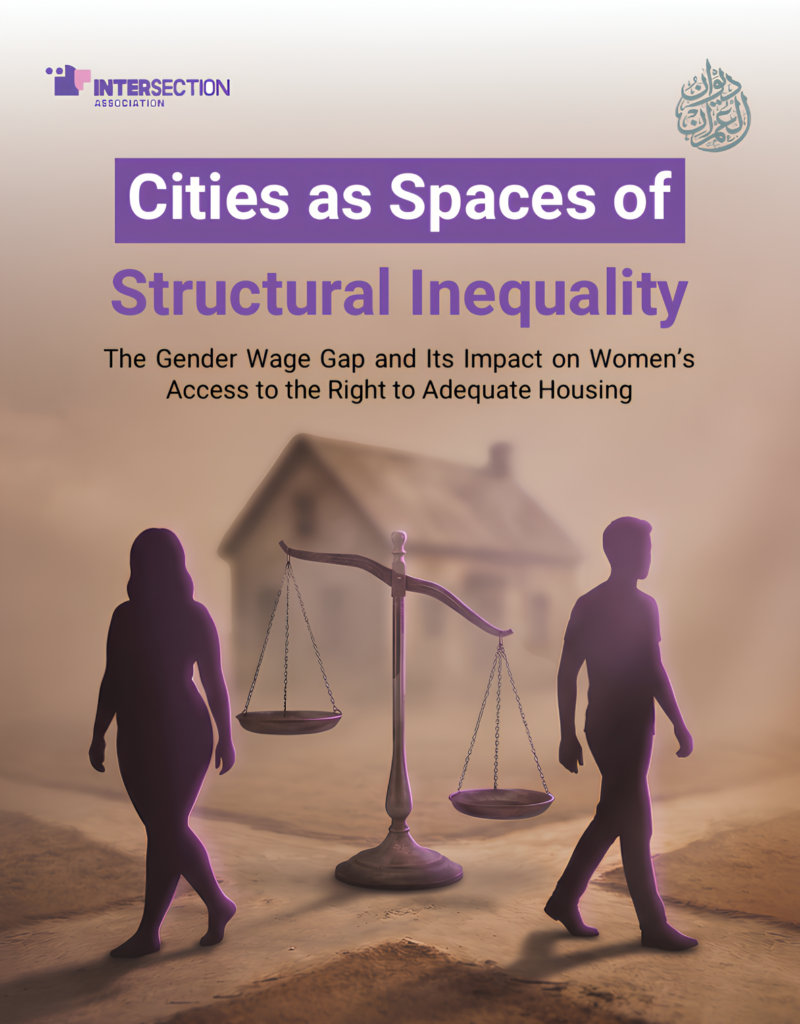
You can access the report via this link: Cities as Spaces of Structural Inequality
“Diwan Al-omran” in partnership with “Intersection Association for Rights and Freedoms”, has published a research paper titled “Cities as a Factor of Inequality: The Gender Pay Gap and Its Impact on Women’s Access to Adequate Housing”.
The paper emphasizes the structural relationship between economic inequality in the labor market and women’s ability to access adequate housing in Arab cities while presenting a comparative study of Egypt and Tunisia, examining how labor market discrimination undermines the realization of the right to adequate housing.
The paper explores how cities, instead of serving as spaces of opportunity, can become environments that reproduce inequality, especially gender-based. The outcomes show that the gender pay gap is not just a difference in income, but a factor affecting women’s ability to afford and access housing, particularly with continuously rising housing and service costs.
Data reveals that the gender pay gap in Egypt exceeds 20% in favor of men and rises further when accounting for women excluded from the labor market. In Tunisia, the gap stands at approximately 10.4%, with clear indications of its structural and gendered nature. This imbalance directly impacts women’s access to housing, reducing it to around 80% in Egypt and 90.6% in Tunisia compared to men.
The paper also emphasizes that housing costs extend beyond rent or ownership, encompassing additional burdens such as basic services and transportation. These costs disproportionately affect women, increasing their vulnerability to housing insecurity and instability. As a result, many women are compelled to accept lower-quality housing or engage in involuntary shared living arrangements, while facing higher risks of eviction due to financial constraints.
The paper concludes that addressing this issue requires a comprehensive approach that does not separate housing policies from labor market policies, but rather integrates them within a gender-sensitive, rights-based framework.
Key recommendations include reducing the gender pay gap, designing more equitable housing policies, improving women’s access to housing finance, strengthening tenure security, and enhancing the availability of gender-disaggregated data to support evidence-based policymaking.
The paper concludes that women’s right to adequate housing cannot be ensured without addressing the root causes of inequality, especially the gender pay gap, which drives urban exclusion in Arab cities.
You can access the report via this link: Cities as Spaces of Structural Inequality