
Women Condemned by Stigma and Prison
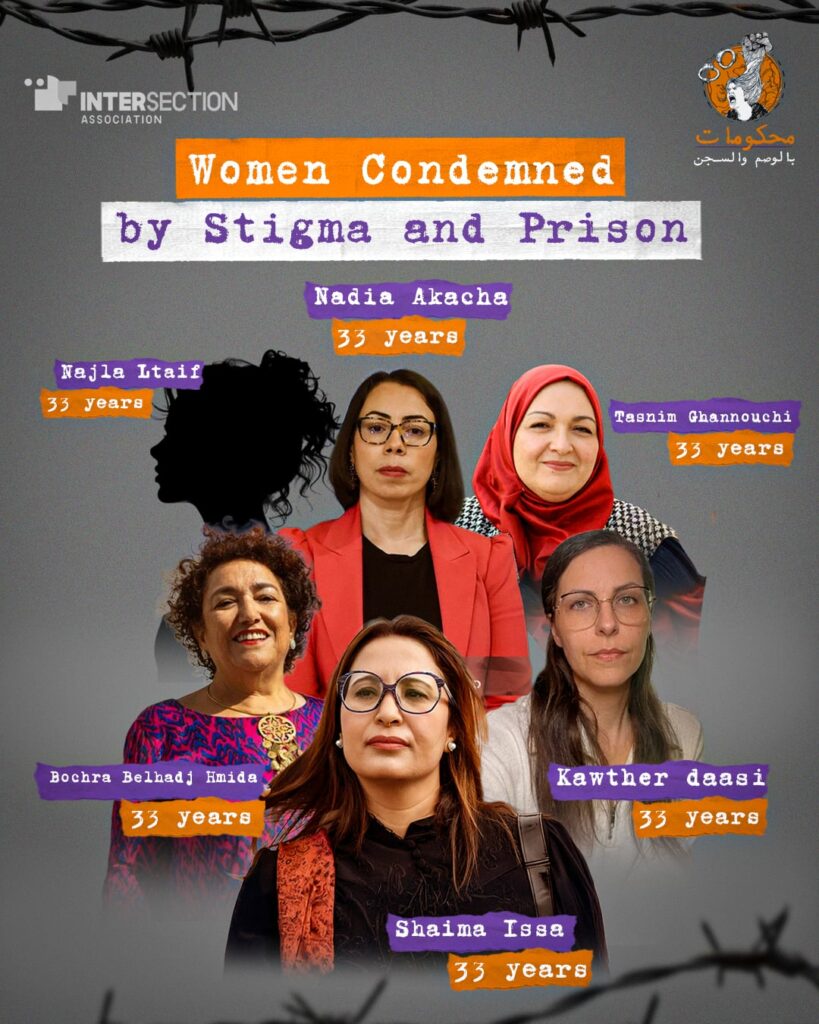
The recent appellate judgments handed down in what has come to be known publicly as the “Conspiracy Against State Security Case” mark a deepening phase of repression and exclusion directed at women in Tunisia’s public sphere. Intimidation has evolved into an overt instrument deployed to silence and weaken women activists. These judgments cannot be read as neutral judicial determinations; they operate instead as unambiguous political signals that women who dare to participate in public life risk imprisonment, digital mobbing, and physical aggression, measures that collectively form a deliberate strategy to diminish their visibility and expel them from civic space.
The singling out of women in this case reveals a conscious attempt to reassert a patriarchal doctrine of guardianship. The law is transformed into a tool of coercion against women human-rights defenders and a warning to younger women that the public sphere is not intended for them. This is starkly embodied in the violations inflicted on activist Chaima Issa, who was abducted during a feminist mobilisation and subsequently subjected to physical dragging and online vilification, penalties she incurred solely for her oppositional stance.
Beyond Chaima Issa, prosecutions have extended to other women, among them Bochra Belhaj Hmida, Najla Ltaief, and Kawthar Daassi, whose names appeared on the indictment list and who received severe judgments in absentia. Their cases illustrate the persistent instrumentalisation of the judiciary against women engaged in rights advocacy, compounding the legal and political precarity of their protections and raising grave questions regarding the State’s willingness to safeguard women defenders of rights and liberties.
However varied the forms of political pressure may be, their outcome converges on a single aim: the intensification of women’s vulnerability and the consolidation of exclusionary public policies. The abduction of Chaima Issa was neither a routine security measure nor a straightforward execution of a judicial order. It constituted a declaration of enmity toward women who insist on occupying public space, turning their bodies and freedoms into terrain for political score-settling.
These infringements signal that the State is actively reproducing a systematised patriarchal order, one that casts women’s political presence as a threat to national security and reshapes public space into a restricted domain. Judicial repression intertwines with coordinated online harassment to cement both digital and physical regimes of constraint, pushing women back into enforced silence and the imposed role of victim. Through these mechanisms, an exclusionary social order is reinstated, one that relies on the marginalisation of women and their displacement from meaningful, participatory engagement in public life.