
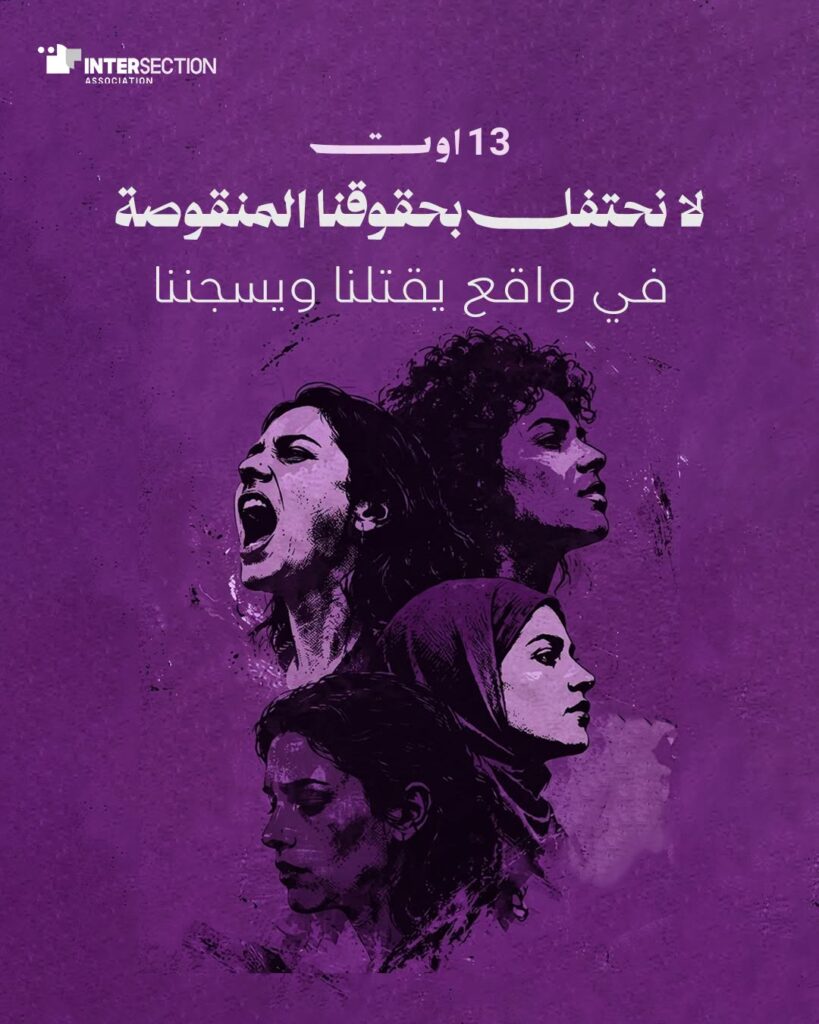
13 August 2026 is meant to be a day of celebration for Tunisians. It marks the anniversary of the adoption of the Personal Status Code in 1956, a major milestone in regulating family life and advancing equality between women and men. For generations, the Code represented hope for stronger women’s rights and a life of dignity. It also represented progress against the pressures of a patriarchal society intertwined with class inequalities.
Yet this occasion loses its meaning when it becomes an official celebration detached from the realities of women’s lives and rights. While the State presents itself as the “protector” of Tunisian women, violations against women continue across all areas of their lives. They occur in the streets, fields, factories, homes, and digital spaces, affecting rights that range from basic freedoms to the right to life itself.
This contradiction is particularly evident in the situation of women human rights defenders in prison; in women who are killed amid increasing vulnerability and the absence of effective protection; and in women agricultural workers who lose their lives in “death trucks,” their deaths reduced to passing news stories without scrutiny of the economic structures that exploit their bodies. It is equally visible in the marginalization of Black women and queer women, who face intersecting forms of violence based on race, class, sexual orientation, and gender identity, and are pushed to the margins of the margins within public policies and superficial discourses of “equality.”
These violations are compounded by the tolerance of violence within political spaces, including Parliament. Women activists and women human rights defenders also face racism, online public shaming, and systematic psychological violence. Women who are already socially and economically marginalized are particularly affected. This includes queer women, who face multiple forms of marginalization and exclusion. At the same time, everyday issues affecting women’s lives remain neglected. These include water and electricity cuts and environmental pollution, which disproportionately affect low income, Black, and rural women. This reflects the intersection of environmental, social, and gender based exploitation.
At Intersection Association for Rights and Freedoms, we choose this occasion to challenge the official narrative and shed light on women’s realities through an intersectional feminist lens. From this perspective, violence against women is not a series of isolated incidents, but a direct consequence of policies and structures that produce marginalization and impoverishment. Treating these violations as “individual cases” only enables the violence behind them to persist.
We remind the State that women’s rights are neither a favor nor a matter of official rhetoric. The Personal Status Code cannot serve as a symbolic cover for the declining protection of women’s rights. Equality cannot be measured by legal texts alone. It must also be measured by whether women, particularly Black, rural, marginalized, and queer women, can live in dignity and safety and exercise their rights without fear of violence, discrimination, or exclusion.
On this occasion, we bring attention to the women erased from public space and official discourse: women agricultural workers who pay with their lives for an unjust economy; women working in the informal economy; women subjected to systematic domestic and societal violence; women who are killed and whose lives are then reduced to cold statistics; women human rights defenders prosecuted and imprisoned for their activism; and Black and queer women who face intersecting forms of violence that make their very existence an act of daily resistance.
We reject the reduction of women to a symbolic façade used to polish the image of the State while their voices are met with vilification, repression, or disregard. We also reject the continued treatment of violence against women as a series of isolated incidents, when its recurrence and scale reveal a deep structural crisis in public policies and a failure to dismantle the intersecting systems of domination that produce and reproduce this violence.
Accordingly, we call on the State and public authorities to move from celebration to justice, and from managing symbols to dismantling the structures that produce inequality. This requires ensuring effective protection for women against violence; holding perpetrators and institutions accountable; advancing social and environmental justice; guaranteeing women’s economic independence; and adopting a genuinely intersectional approach that recognizes the multiple forms of discrimination faced by women, particularly Black, low-income, rural, and queer women.
On this anniversary, Intersection Association for Rights and Freedoms reaffirms its commitment to a future where women’s rights are more than official slogans. They must be lived and realized every day, through justice, radical equality, dignity, and the full recognition of all women, without exception or discrimination.