
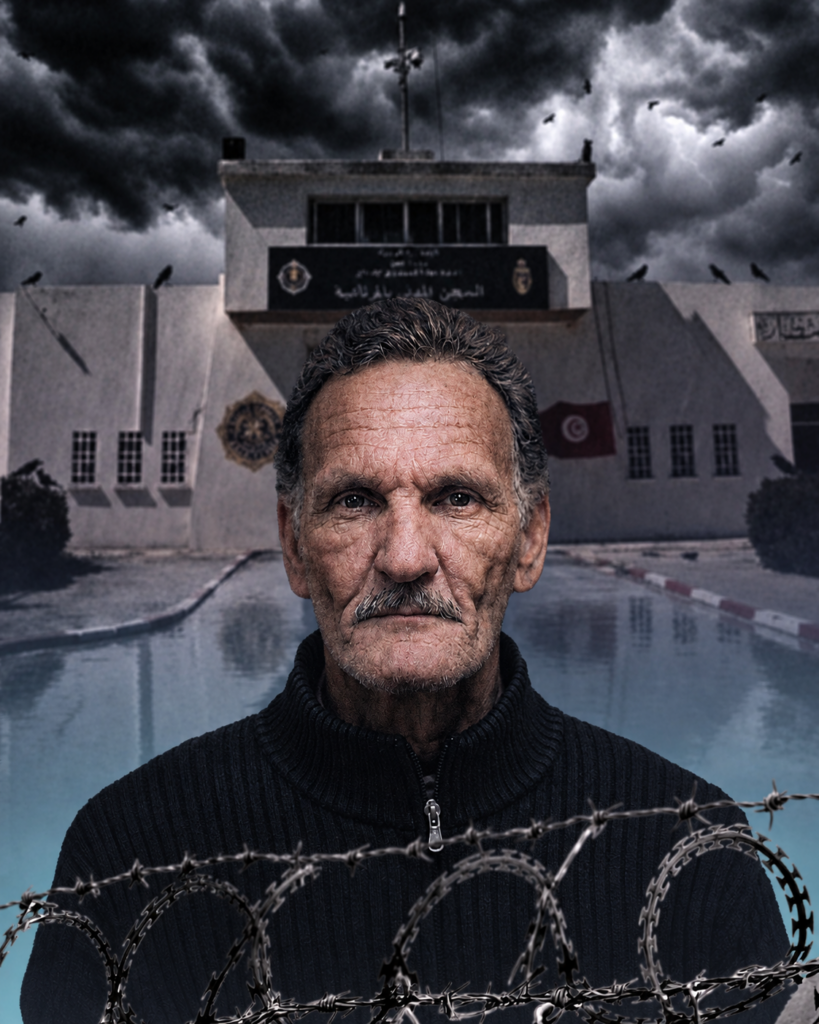
Hedi Mejri
Summary
Hedi Mejri, a 67-year-old Tunisian man residing in Sidi Hassine, was arrested on 16 December 2025 and then placed in Mornaguia Civil Prison. His health deteriorated rapidly during his detention, and he was later transferred to hospital in critical condition without his family being informed, before his death was recorded on 1 January 2026 in circumstances suggesting that he had been subjected to torture and ill-treatment. Despite the judicial and administrative steps taken by the family to uncover the circumstances of the death and hold those responsible to account, these efforts did not lead to the opening of an actual or serious investigation into the case.
Personal information
Name: Hedi Mejri.
Age: 67 years.
Nationality: Tunisian.
Governorate: Tunis.
Status: Citizen.
Events of the violation
Hedi Mejri is a 67-year-old man. According to his daughter's testimony, noticeable changes had occurred in his behavior and conduct over the past year. His daughter had previously tried to take him to a psychiatric hospital for treatment, but he ran away before the procedures were completed.
On 8 December 2025, his daughter prepared a petition accompanied by testimonies and signatures from family members and neighbors, setting out her father's behavior, and submitted it to the Tunis 2 Court of First Instance with a view to obtaining a compulsory hospitalization order in a public hospital for his treatment. However, the competent authorities informed her that the signatures had to be certified at the municipal services before the request could be considered.
On 16 December 2025, he was taken to the National Security post in El Attar, Sidi Hassine, where he was held in custody, after consultation with the Public Prosecution, in connection with a criminal case. On 18 December 2025, he was brought before the investigating judge at the Tunis 2 Court of First Instance, who issued a committal order against him, and he was transferred to Mornaguia Civil Prison.
His daughter visited him in prison on 23 December 2025 and noticed a serious deterioration in his physical and mental condition: he was crying and saying that his leg was broken, uttering incomprehensible words, and the telephone fell from his hand several times before he collapsed and was unable to complete the visit. She believed there were indications that he had been subjected to violence and ill-treatment.
Following this, she filed a complaint with the prison's citizens' service office and was told that the matter would be looked into.
On 25 December 2025, his health worsened, and he was transferred to the orthopedics department of Charles Nicolle Hospital without the family being informed.
The following day, 26 December 2025, his daughter tried to visit him in prison, but her request was refused on the grounds that he had been taken out in the morning for a medical examination, without any further explanation. When she insisted on waiting, one of the officers told her that he had been in hospital since the previous night and that there was no point in waiting.
On 31 December 2025, the prison administration contacted his daughter to inform her that her father's condition was very critical. The following day, 1 January 2026, she was able to visit him at the hospital at 5:00 a.m., where he was in a coma. At 7:00 p.m. that same day, Hedi Mejri died in suspicious circumstances suggesting that he had been subjected to violence and ill-treatment during his detention.
In the course of following up on the case, an inquiry into the matter was opened; however, as of the preparation of this documentation, the investigations have produced no significant results or any actual accountability of those responsible.
Human rights violations
The available information, based on his daughter's testimony and the sequence of events, indicates that Hedi Mejri, aged 67, suffered from evident psychological disorders that had warranted a request for compulsory hospitalization before his arrest. Nevertheless, he was detained in Mornaguia Civil Prison instead of being transferred to a specialized hospital facility, which constitutes a serious violation of the right to health care and of the duty to protect vulnerable groups from neglect.
This is confirmed by the provisions of the "Nelson Mandela Rules" on the need not to detain persons with severe intellectual or psychosocial disabilities in prisons, but rather in appropriate health facilities. Moreover, the Public Prosecution's disregard for his health condition when placing him in custody points to the State's failure to fulfill its duty to protect vulnerable groups.
According to his daughter's account, he told her that his leg was broken, he showed clear signs of physical collapse, and he was uttering incomprehensible words. This information indicates suspicions of torture or cruel or degrading treatment, which constitutes a flagrant breach of the prohibition of torture and of inhuman or degrading treatment set out in Article 5 of the Universal Declaration of Human Rights, as well as of Rule 1 of the Nelson Mandela Rules, which affirms that all prisoners, men and women, must be treated with respect for their inherent dignity.
Furthermore, the transfer of Hedi Mejri to Charles Nicolle Hospital without informing the family, followed by the misleading information his daughter was given when she tried to visit him the next day, when she was told that he had "been taken out for a simple medical examination" while he had in fact been admitted to hospital since the previous night, constitutes a flagrant violation of the duty to inform the family and of the principle of transparency, under Rule 68 of the Nelson Mandela Rules, which requires prison administrations to notify the family immediately when a prisoner suffers a serious illness or is transferred to a medical institution.
The death of Hedi Mejri, who died in a coma on 1 January 2026 after his health deteriorated in prison, falls within the category of "suspicious deaths" in places of detention occurring in abnormal circumstances. Under international standards, the State bears legal responsibility for the life of every person it detains, and any death in this context gives rise to a presumption of State responsibility, whether owing to its negligence or as a result of acts attributable to its agents.
Although the Public Prosecution opened an inquiry into the circumstances of the death, the absence of tangible results or actual accountability as of the date of preparation of this documentation points to persistent impunity.
International standards, including Rule 71 of the Mandela Rules, require a prompt, independent, impartial and effective investigation into every death in prison. Moreover, the continuation of the investigations without clear results is likely to raise serious concerns about the transparency and independence of the inquiry process.
Accordingly, the case of Hedi Mejri reflects a combination of serious medical neglect, possible ill-treatment and breaches of procedural safeguards, including the failure to inform the family in a timely manner, which ultimately resulted in his deprivation of the right to life while under the responsibility of the detaining authority. This case highlights the urgent need to establish independent and effective oversight mechanisms to guarantee the rights of detainees, men and women, and to protect their lives and health.