
Mohamed Yousfi: From Legal Proceedings to Imprisonment
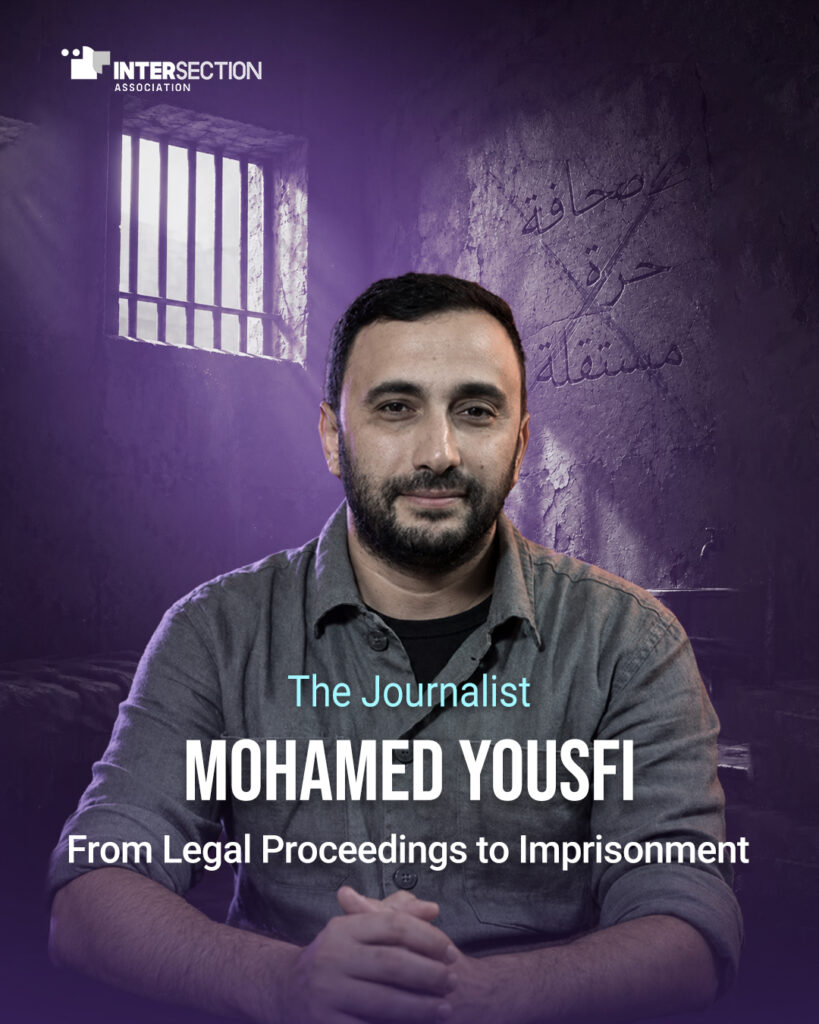
Summary:
Mohamed Yousfi, journalist and Editor-in-Chief of “Alqatiba” news website, was arrested on the evening of Friday, 4 September 2026, following a smear campaign targeting him on social media. Among other charges, he was accused of suspected illicit enrichment and money laundering.
While in police custody, Yousfi underwent emergency surgery to remove his appendix. Despite his medical condition, his detention was extended. His health then deteriorated sharply while further questioning was being carried out on 8 September 2026. Before the questioning was completed, a pre-trial detention order was issued against him.
His defence team stated that the decision was marked by several procedural violations.
Personal Information
Name: Mohamed Yousfi
Nationality: Tunisian
Occupation: Journalist, Editor-in-Chief of “Alqatiba”, and lecturer at the Institute of Press and Information Sciences
Region: Tunis
Charges:
Forming an organisation with the aim of assaulting persons and property; illicit enrichment; and money laundering by an organised group or association through the use of facilities allegedly made available by the accused’s position and professional and social activities, under the following legal provisions:
-Penal Code: Articles 131 and 132.
-Organic Law No. 26 of 2015, dated 7 August 2015, on combating terrorism and preventing money laundering, as amended by Organic Law No. 9 of 2019, dated 23 January 2019: Articles 92, 93, 94, 95, 96, 97, 99, 100, 125, 126, 136 and 140.
-Law No. 46 of 2018, dated 1 August 2018, on the declaration of assets and interests and the fight against illicit enrichment and conflicts of interest: Articles 3, 4, 37, 42, 43 and 45.
Methodology:
Intersection Association for Rights and Freedoms prepared this documentation in accordance with a methodology based on monitoring, verification and documentation. This involved collecting information from reliable media sources, reviewing and verifying the available information, and organising it according to the chronological and procedural sequence of events.
The Association also supplemented the available information with first-hand details gathered through a phone call with Mohamed Yousfi’s defence team, in order to verify the reported events and obtain further information about the course of the case and the judicial procedures taken.
In addition, the Association adopted a legal and human rights approach to analysing the events in light of the provisions of the 2022 Constitution of the Republic of Tunisia and Tunisia’s obligations under international human rights standards and instruments, particularly those relating to the right to liberty and security of person, fair trial guarantees, the protection of physical integrity and conditions of detention.
Violation Incidents:
Mohamed Yousfi is a Tunisian journalist and Editor-in-Chief of “Alqatiba”, a news website covering public affairs, political and human rights issues, including freedom of opinion and expression, democracy, and investigative reporting on corruption.
Before his arrest, Yousfi had been the target of an ongoing campaign on social media involving attacks and smear campaigns linked to his journalistic work and positions.
On the evening of Friday, 4 September 2026, as Yousfi was preparing to enter the premises of Express FM Radio[1] to take part in a discussion programme on Tunisia’s water crisis and present his book Thirsty Tunisia, he was arrested by a security unit affiliated with the National Unit for the Investigation of Complex Financial Crimes. His mobile phone was seized, and he was taken to the Third Central Unit for the Investigation of Complex Financial Crimes of the National Guard in El Aouina. He was then placed in police custody until the morning of Saturday, 5 September 2026.
The arrest followed an order issued by the Public Prosecutor’s Office on the same day, based on what it described as “repeated and consistent information and evidence” suggesting that Yousfi was involved in an agreement to organise money-laundering operations by exploiting facilities allegedly made available through his position and professional activities. The allegations also included suspected tax evasion and illicit enrichment.
According to the information referred to the Public Prosecutor’s Office, the allegations were based on posts and comments circulating on social media. These publications focused in particular on what they described as a rapid increase in Yousfi’s wealth, referring to bank accounts and real estate allegedly linked to unknown sources of income.
In response, the defence team, through lawyer Hela Ben Salem [2], stated that the Public Prosecutor’s report merely referred to the existence of “repeated and consistent information” without explaining how it had been verified or identifying its sources. She described the case file as having been “built on a series of assumptions”. The defence team also stated that there was no banking evidence indicating unusual financial transactions, no property documents, and no financial investigations supporting the charges brought against Yousfi. The lawyer considered that her client was not being targeted as an individual, but because of his principles, positions and professional activities.[3]
Meanwhile, during the night between Friday, 4 September and Saturday, 5 September 2026, Yousfi suffered an acute medical emergency that required his transfer to hospital. He underwent emergency surgery to remove his appendix while still in police custody.[4]
Despite having undergone surgery, his detention was extended on 7 September 2026 for an additional 48 hours. The National Union of Tunisian Journalists considered this development extremely serious, raising significant concerns about whether the authorities responsible for his detention had taken the necessary measures to protect his physical integrity and health.
Following the expiry of his detention period,[5], Yousfi appeared before an investigating judge at the Economic and Financial Judicial Pole on Tuesday for further questioning. However, his medical condition and the severe pain he was experiencing around the surgical site prevented the questioning from proceeding, as he was not physically able to speak or answer questions.
According to the defence team, this prompted the authorities to call a Civil Protection doctor to examine him. The doctor, in turn, requested that he be transferred to hospital given the seriousness of his condition. Meanwhile, his lawyers went to a pharmacy to obtain the medication he needed.
Despite his deteriorating health and the fact that the questioning had not been completed, the investigating judge issued a pre-trial detention order against him.[6] The defence team stated that the order was issued under circumstances involving several alleged procedural violations, including the failure to complete the questioning, the denial of the defence team’s opportunity to present its arguments, the issuance of the order in Yousfi’s absence, and the lawyers’ refusal to sign the questioning record.
The following day, Wednesday, 9 September 2026,[7], the administration of Mornaguia Civil Prison refused to stamp the visitation permit issued by the investigating judge to Yousfi’s wife. This prevented her from visiting him at the hospital and delivering his clothes, medication and food.
On the evening of Friday, 11 September 2026, members of the defence team, lawyers Hala Ben Salem and Sami Ben Ghazi, visited Yousfi at Mornaguia Prison. Lawyer Hala Ben Salem[8] stated that Yousfi had been transferred from the hospital to prison on the evening of Thursday, 10 September. She added that his health had improved and that he was recovering from the surgery.
According to the defence team, Yousfi expressed his belief that what he was experiencing was linked to the independent editorial line of “Alaqatiba” and its professional independence. He reportedly stressed that he had “never been an opposition journalist, but an independent journalist who carries out his role and believes in freedom of the media and the press, without working according to any agenda or on behalf of any party”. He described what he was going through as “an attempt at moral assassination and an attempt to silence his voice”.[9]
Human Rights Violations
The case of Mohamed Yousfi raises several human rights and fundamental freedoms concerns. In light of the documented events, it gives rise to concerns about possible violations of several rights guaranteed under the Tunisian Constitution and international human rights standards, particularly freedom of the press, opinion and expression; the right to liberty and security of person; the guarantees of defence and a fair trial; the right to humane treatment and medical care while deprived of liberty; as well as the right to privacy and the protection of the confidentiality of journalistic sources.
Regarding freedom of opinion, expression and the press, the use of financial corruption charges against a journalist, in circumstances where the defence team has reported the absence of publicly disclosed material evidence supporting the allegations, and in a context linked to his professional activities, journalistic content or positions, may constitute a restriction on freedom of opinion, expression and the press. Article 37 of the 2022 Constitution of the Republic of Tunisia protects freedom of opinion, thought, expression, information and publication, while Article 38 guarantees the right to information and access to information. Under Article 55 of the Constitution, any restriction on these rights must comply with the principles of legality, necessity and proportionality. This requires that any restriction have a clear legal basis, pursue a legitimate aim, be necessary and proportionate to that aim, and not undermine the essence of the right concerned.
Article 19 of the International Covenant on Civil and Political Rights (ICCPR) also protects freedom of opinion and expression, including the right to seek, receive and impart information and ideas of all kinds. Article 9 of the African Charter on Human and Peoples’ Rights guarantees the right to receive information and to express and disseminate opinions.
At the national level, Article 1 of Decree-Law No. 115 of 2011, dated 2 November 2011, on freedom of the press, printing and publishing, guarantees the freedom to circulate, publish and receive news, opinions and ideas. Any restrictions on these freedoms must comply with the requirements of legality, a legitimate aim, necessity and proportionality.
Article 11 of the same decree-law protects the confidentiality of journalists’ sources, while Article 12 prohibits the use of a journalist’s published opinions or information as grounds for undermining their dignity or physical or moral integrity.
Accordingly, a possible legal assessment of this case cannot be based solely on the fact that Yousfi is a journalist and was arrested. It depends primarily on whether a causal link can be established between his journalistic activities, opinions or published content and the criminal proceedings brought against him.
If the judicial documents establish that the alleged acts are genuinely separate from his journalistic activities and are supported by independent, objective evidence, his status as a journalist alone would not be sufficient to consider the proceedings an infringement of press freedom. However, if it is established that his journalistic work or editorial positions were a direct reason for, or a pretext for, the proceedings, this could amount to an unlawful restriction on freedom of expression and the press, particularly if the restriction does not meet the tests of legality, necessity and proportionality.
Regarding the right to liberty and security of individuals, the documented events indicate that Yousfi was arrested on the evening of 4 September 2026 while on his way to carry out a journalistic activity. He was taken to the Financial Crimes Investigation Unit in El Aouina, and his detention was subsequently extended for an additional 48 hours on 7 September. He then appeared before an investigating judge at the Economic and Financial Judicial Pole on 8 September, after which an order was issued for his pre-trial detention.
This sequence of events is legally significant, as deprivation of liberty is not lawful merely because an order has been issued or a suspicion exists. It must comply with the legal conditions and safeguards, and must not become arbitrary or unnecessary.
In this context, Yousfi’s place of residence and workplace are known to the authorities, meaning that he could have been summoned, if necessary, without resorting to arrest in this manner. The available information also indicates that he did not pose a threat to others or to the course of the investigation, and that he was not caught in the act in circumstances that would justify his arrest as carried out.
Article 35 of the 2022 Constitution of the Republic of Tunisia protects individual liberty and subjects arrest and detention procedures to legal safeguards. Article 9 of the ICCPR guarantees the right to liberty and security of individuals and prohibits arbitrary arrest or detention. Article 6 of the African Charter on Human and Peoples’ Rights likewise protects individuals against arbitrary arrest and detention.
Accordingly, the legal question is not simply whether an arrest or pre-trial detention order was issued, but whether the legal requirements for these measures were met; whether there were factual and legal grounds justifying deprivation of liberty rather than less restrictive measures; and whether the applicable time limits, procedures and safeguards governing detention were respected.
These concerns are also connected to the guarantees of defence and a fair trial, particularly in light of the events reported during the questioning session on 8 September 2026. The circumstances raise a fundamental question regarding respect for the rights of the defence, the principle of adversarial proceedings and the basic safeguards applicable when appearing before an investigating judge.
In this regard, Article 124 of the 2022 Constitution of the Republic of Tunisia guarantees the right to seek justice and the right to defence. Article 14 of the ICCPR guarantees the right to a fair trial, including the right to prepare and exercise one’s defence, while Article 7 of the African Charter on Human and Peoples’ Rights establishes guarantees relating to the right to defence.
At the national level, Article 69 of the Code of Criminal Procedure requires the investigating judge, during the first appearance, to inform the person under investigation of the acts attributed to them and the applicable legal provisions, and to allow them to exercise their right not to answer questions except in the presence of a lawyer.
Therefore, issuing a pre-trial detention order before questioning has been completed, or without effectively allowing the defence to exercise its rights, is not merely a procedural formality. It may undermine the guarantees of defence that are directly relevant to the lawfulness of the judicial measure.
Article 80 of the Code of Criminal Procedure also provides that, after questioning the person under investigation and obtaining the opinion of the Public Prosecutor, the investigating judge may issue a detention warrant if the alleged offence is punishable by imprisonment or a more severe penalty.
Yousfi’s medical condition also raises concerns about the protection of his physical integrity and access to healthcare while in custody, particularly after he underwent emergency surgery and his condition subsequently deteriorated to the extent that he was unable to complete the questioning.
This raises questions about compliance with Article 25 of the 2022 Constitution of the Republic of Tunisia, which protects human dignity and bodily integrity and prohibits physical and moral torture, as well as Article 36, which guarantees every prisoner the right to humane treatment that preserves their dignity.
Article 10 of the ICCPR guarantees that all persons deprived of their liberty must be treated with humanity and respect for their inherent human dignity. Article 5 of the African Charter provides similar protection. Article 13 bis of the Code of Criminal Procedure also establishes safeguards relating to the medical examination of persons in custody.
Regarding the right to communicate with family members, the available information indicates that the prison administration refused to stamp the visitation permit issued by the investigating judge to Yousfi’s wife. This prevented her from visiting him and delivering his clothes, medication and food. This incident is particularly significant given that the visit was authorised by the investigating judge.
Contact with family members is one of the fundamental safeguards for persons deprived of their liberty. Rule 58 of the Nelson Mandela Rules provides that prisoners should be allowed to communicate with their families and receive visits at regular intervals. Rule 43 further stipulates that restrictions on contact with family members may only be imposed for a limited period and to the extent required by security and order considerations. Accordingly, refusing to implement the authorised visit, without a clear legal basis or a legitimate and proportionate security justification, may constitute an infringement of Yousfi’s right to maintain contact with his family and of the basic safeguards governing the treatment of persons deprived of their liberty.
As for the mobile phone seized during the arrest, the incident raises two separate legal questions: the lawfulness of seizing the device itself, and the lawfulness of accessing its contents and using the data stored on it.
Article 30 of the 2022 Constitution of the Republic of Tunisia protects the right to privacy, the inviolability of the home, the confidentiality of correspondence and communications, and the protection of personal data. Article 11 of Decree-Law No. 115 of 2011 also protects the confidentiality of journalists’ sources. Therefore, the seizure of Yousfi’s phone raises concerns about possible interference with his right to privacy and the confidentiality of his communications and personal data. It may also directly affect the specific protection afforded to the confidentiality of journalistic sources.
In all these circumstances, the presumption of innocence remains in force until a final judicial ruling is issued. Article 33 of the 2022 Constitution of the Republic of Tunisia guarantees the presumption of innocence, which is also affirmed in Article 14(2) of the ICCPR.
Accordingly, the charges and suspicions under investigation, including those relating to illicit enrichment, money laundering and any other alleged acts, cannot be presented as established facts or proven criminal liability. They must instead be treated as allegations or suspicions subject to judicial investigation. Likewise, the pre-trial detention order does not constitute a conviction and does not establish the truth of the acts attributed to him.
[1] Express FM, 2026, Journalist Mohamed Youssefi Arrested Outside Express FM Radio Headquarters, 4 September. Last accessed: 30 September 2026.
https://radioexpressfm.com/ar/%D8%A7%D9%84%D8%A3%D8%AE%D8%A8%D8%A7%D8%B1/%D8%A5%D9%8A%D9%82%D8%A7%D9%81-%D8%A7%D9%84%D8%B5%D8%AD%D9%81%D9%8A-%D9%85%D8%AD%D9%85%D8%AF-%D8%A7%D9%84%D9%8A%D9%88%D8%B3%D9%81%D9%8A-%D9%85%D9%86-%D8%A3%D9%85%D8%A7%D9%85-%D9%85%D9%82%D8%B1-%D8%A5/
[2] Telephone interview with Mohamed Youssefi’s lawyer, 14 September 2026.
[3] International Federation of Journalists (IFJ), 2026, Tunisia: IFJ Calls for the Immediate Release of Journalist Mohamed Youssefi, 7 September. Last accessed: 30 September 2026.
https://www.ifj-arabic.org/%D8%A3%D8%AE%D8%A8%D8%A7%D8%B1/%D8%A7%D9%84%D8%AA%D9%81%D8%A7%D8%B5%D9%8A%D9%84?tx_news_pi1%5Baction%5D=detail&tx_news_pi1%5Bcontroller%5D=News&tx_news_pi1%5Bnews%5D=24188&tx_news_pi1%5BoverwriteDemand%5D%5Bcategories%5D=20&cHash=bda6c075f982fb07565c1be6a92ea36c
[4] Inkyfada, 2026, The Mohamed Youssefi Case: From Facebook Posts to Financial and Terrorism-Related Charges, 9 September. Last accessed: 30 September 2026.
https://inkyfada.com/ar/2026/09/09/%D9%82%D8%B6%D9%8A%D8%A9-%D9%85%D8%AD%D9%85%D8%AF-%D8%A7%D9%84%D9%8A%D9%88%D8%B3%D9%81%D9%8A-%D9%85%D9%86-%D9%85%D9%86%D8%B4%D9%88%D8%B1%D8%A7%D8%AA-%D8%B9%D9%84%D9%89-%D9%81%D8%A7%D9%8A%D8%B3%D8%A8/
[5] Al Jazeera, 2026, Following His Arrest Outside a Radio Station, Tunisia Orders Journalist Mohamed Youssefi to Be Held in Custody, 5 September. Last accessed: 30 September 2026.
[6] Mosaique FM, 2026, Pre-trial Detention Warrant Issued Against Journalist Mohamed Youssefi, 8 September. Last accessed: 30 September 2026.
[7] National Union of Tunisian Journalists (SNJT), 2026, Mohamed Youssefi’s Imprisonment in Violation of Procedures and Disregard for His Serious Health Condition, 8 September. Last accessed: 30 September 2026.
[8] Telephone interview with Mohamed Youssefi’s lawyer, 14 September 2026.
[9] Letter from journalist Mohamed Youssefi, conveyed by his defence team.