Summary
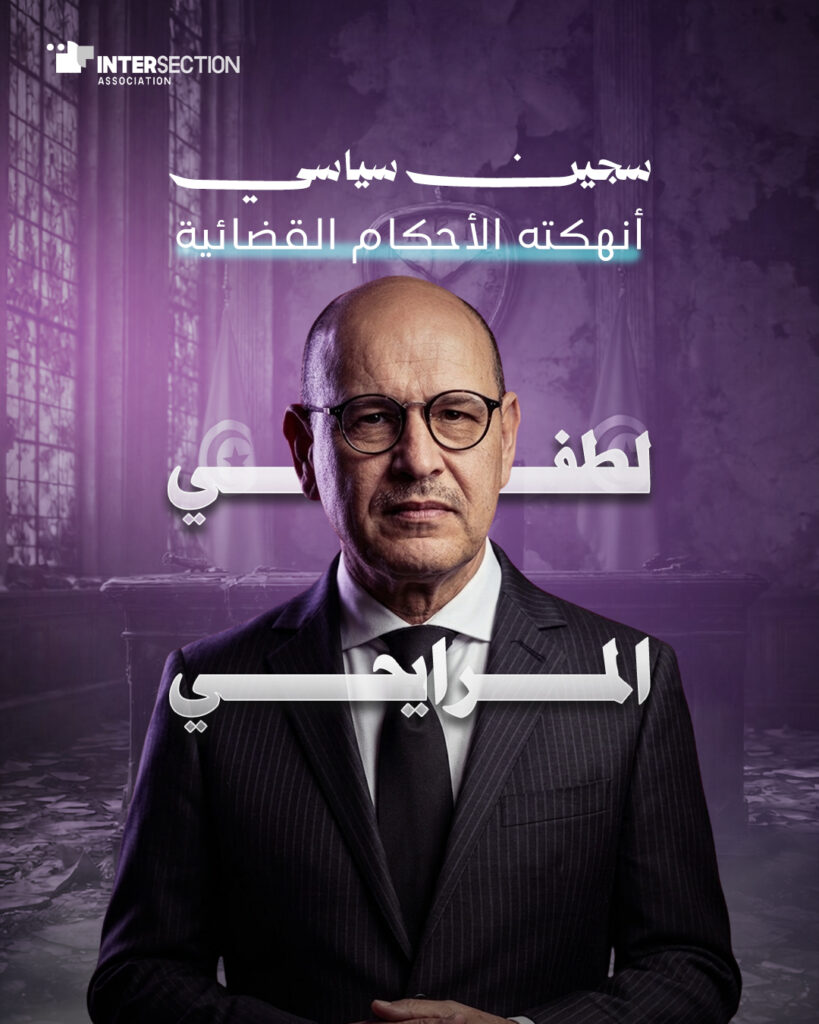
Lotfi Mraihi, Secretary General of the Popular Republican Union Party, has faced a series of judicial proceedings that began following media statements he made in late 2022 and later expanded, after he announced his intention to run in the 2024 presidential election, to include cases involving electoral and financial offences. He was sentenced on appeal to six months in prison in the case brought under Article 24 of Decree-Law No. 54 of 2022, and to six months in prison with a lifetime ban from standing for election in the endorsements case. He was also sentenced at first instance to six years in prison in the case involving money laundering and financial offences. An appeal against this judgment remained pending as of the date of this documentation.
Personal Information
Name: Lotfi Mraihi
Age: 67
Occupation: Tunisian politician, writer, and physician; Secretary General of the Popular Republican Union Party
Nationality: Tunisian
Governorate: Tunis
Charges:
- Using information and communication networks and systems to produce, promote, publish, send, or prepare false news, data, or rumours, or fabricated, falsified, or falsely attributed documents, with the aim of infringing the rights of others, harming public security or national defence, or spreading fear among the population, under Article 24 of Decree-Law No. 54 of 2022.
- Forming an association for the purpose of money laundering, transferring assets abroad, and transactions between residents and non-residents, under Articles 92, 93, 94, 95, 96, and 97 of Organic Law No. 26 of 2015 on Combating Terrorism and Preventing Money Laundering, and Articles 1, 16, 22, 35, 36, and 37 of Law No. 18 of 1976 governing foreign exchange and foreign trade.
- Providing cash gifts to influence voters, under the amended Article 161 of Organic Law No. 16 of 2014, as amended by Decree-Law No. 55 of 2022.
Methodology:
Intersection Association for Rights and Freedoms prepared this documentation through systematic monitoring. The Association collected and verified information from reliable, cross checked media sources and organized it according to the chronological and procedural development of the cases.
The Association supplemented this documentation with first-hand information obtained through a telephone interview with Lotfi Mraihi’s wife on 17 July 2026 and a telephone interview with his lawyer on 23 July 2026, in order to verify the facts and complete the information concerning the cases and judicial proceedings.
The Association also adopted a legal and human rights-based approach to analysing the facts in light of the 2022 Constitution of the Republic of Tunisia and Tunisia’s international obligations, particularly those concerning fair trial guarantees and the right to liberty and security of person.
Events of the Violation:
Lotfi Mraihi is a pulmonologist, Secretary General of the Popular Republican Union Party, and Tunisian politician who ran in the 2019 presidential election and announced his intention to run in the 2024 presidential election.
The first judicial proceedings against him date back to November 2022, when, in his capacity as Secretary General of the Popular Republican Union Party, he made media statements concerning public affairs and the political situation in Tunisia. His statements included an assessment of President Kais Saied’s performance, in which he argued, according to the radio programme, that the President had failed in managing several issues and that his popularity had declined. These statements formed the basis for his prosecution on charges of disseminating information deemed false.
On 22 January 2024, the Court of First Instance in Tunis sentenced him to six months’ imprisonment, suspended, in proceedings brought under Article 24 of Decree-Law No. 54 of 2022.
On 2 April 2024, Mraihi published a video on his official social media page announcing his intention to run in the 2024 presidential election and expressing a number of political positions concerning the general situation in the country. Subsequently, the Sub-Directorate for Economic and Financial Investigations opened an investigation with authorization from the Public Prosecutor’s Office at the Court of First Instance in Tunis, marking the beginning of a series of judicial proceedings that later expanded to several cases.
According to Mraihi’s lawyer, these investigations included searches and inquiries involving members of his family and several party members.
On 1 July 2024, the Public Prosecutor’s Office at the Court of First Instance in Tunis ordered the opening of a judicial investigation against Mraihi and Leila Kallel, Executive Director of the Popular Republican Union Party, over suspicions of money laundering, transferring assets abroad, and opening bank accounts abroad without authorization from the Central Bank of Tunisia. The investigation was based on inquiries conducted by the Sub-Directorate for Economic and Financial Investigations.
On the night of Wednesday, 3 July 2024, Mraihi was arrested pursuant to a wanted notice issued against him in connection with investigations into suspected money laundering. He was subsequently referred to the competent judicial authorities as part of investigations into suspected financial and electoral offences.
According to his lawyer, the referral decision was issued before the beginning of the period for submitting presidential candidacy applications, which Presidential Order No. 351 of 2024 set from 29 July to 6 August 2024.
Mraihi’s lawyer also told Intersection Association for Rights and Freedoms that his client had neither begun collecting endorsements nor formally submitted his candidacy for the presidential election, but was nevertheless charged in relation to endorsements. According to the defence, the alleged acts occurred before the legal start of the electoral period and before Mraihi had formally begun the candidacy process.
On 4 July 2024, Mraihi’s official page published a video recorded before his arrest in which he rejected the judicial proceedings against him, arguing that they stemmed from his exercise of the right to express his views. He also referred to summonses for questioning and a travel ban to which he said he had been subjected.
On 5 July 2024, the Investigating Judge at the Court of First Instance in Tunis issued two detention warrants against Mraihi. The first concerned charges of forming an association for the purpose of money laundering, transferring assets abroad, and transactions between residents and non-residents. The second concerned suspected falsification of electoral endorsements and the provision of cash gifts to influence voters. He remained in pretrial detention in connection with these two cases from that date.
On 18 July 2024, the Misdemeanour Chamber of the Court of First Instance in Tunis sentenced Mraihi to eight months in prison, together with a lifetime ban from standing for election, in the case commonly referred to in the media as the “purchase of endorsements” or “influencing voters” case, under the amended Article 161 of Organic Law No. 16 of 2014. The judgment was appealed.
On 27 September 2024, the Misdemeanour Chamber of the Tunis Court of Appeal ruled on the appeal in the endorsements case. It upheld the conviction while reducing the prison sentence from eight to six months and maintaining the lifetime ban from standing for election.
In parallel, the Misdemeanour Chamber of the Tunis Court of Appeal examined the appeal in the case brought under Article 24 of Decree-Law No. 54 of 2022. On 22 November 2024, it sentenced Mraihi to six months’ imprisonment, replacing the six-month suspended sentence imposed at first instance. The conviction concerned the use of information and communication systems to publish or promote information deemed false, based on statements he had made during a radio programme.
Despite the issuance of these two judgments, Mraihi remained detained in connection with the money laundering and financial offences case. In February 2025, the Investigating Judge at the Court of First Instance in Tunis extended his pretrial detention.
On 16 March 2026, the Criminal Chamber of the Court of First Instance in Tunis examined an application for his release, rejected it, and adjourned the case until 10 April 2026.
On 10 April 2026, Mraihi appeared with several other defendants before the Criminal Chamber of the Court of First Instance in Tunis. His lawyer stated that Mraihi had been residing in Türkiye and held a residence permit, and that, according to the defence, his financial transactions had been conducted in accordance with the law and there was no serious evidence substantiating the charges against him.
On the same day, the Court sentenced him at first instance to six years in prison for offences involving money laundering, banking and financial offences, and transactions between residents and non-residents, under Articles 92, 93, 94, 95, 96, and 97 of Organic Law No. 26 of 2015 on Combating Terrorism and Preventing Money Laundering, and Articles 1, 16, 22, 35, 36, and 37 of Law No. 18 of 1976 governing foreign exchange and foreign trade.
This is the longest prison sentence issued against him. Although the judgment was appealed, no hearing date had been set as of the date of this documentation.
According to Mraihi’s defence team, he had completed both six-month prison sentences: one in the case brought under Article 24 of Decree-Law No. 54 and the other in the endorsements case. He had therefore served a total of one year in prison since his detention on 5 July 2024. Nevertheless, as of the date of this documentation, he remained in detention due to the separate first-instance judgment sentencing him to six years in prison in the money laundering case.
During Mraihi’s detention, his wife told Intersection Association for Rights and Freedoms that she had requested permission from the Investigating Judge and the prison administration to visit him in person in October 2025. The prison administration denied the request. She submitted another request on 17 July 2026, explaining that Mraihi’s elderly mother also wished to visit him. As of the date of this documentation, the request remained unanswered.
Human Rights Violations:
The documented facts in Lotfi Mraihi’s case raise several human rights concerns relating to freedom of expression, the right to participate in public affairs, the right to liberty and security of person, fair trial guarantees, and the right of persons deprived of their liberty to be treated with respect for their human dignity.
Regarding the judicial proceedings arising from media statements made by Mraihi in 2022, which resulted in a six-month prison sentence on appeal under Article 24 of Decree-Law No. 54 of 2022, the documented facts raise questions concerning respect for freedom of opinion and expression. Article 37 of the 2022 Constitution of the Republic of Tunisia guarantees freedom of opinion, thought, expression, information, and publication. Article 19 of the International Covenant on Civil and Political Rights guarantees everyone the right to hold opinions without interference and the right to freedom of expression, including the freedom to seek, receive, and impart information and ideas. Under international law, any restriction on this right must be provided by law and meet the requirements of necessity and proportionality in pursuit of a legitimate aim.
In this context, Mraihi’s prosecution and conviction under Article 24 of Decree-Law No. 54 of 2022 for statements concerning public affairs and the performance of the President raise human rights concerns regarding the compatibility of the application of this provision with constitutional and international guarantees of freedom of expression, particularly where political opinion or criticism of public officials is concerned. The broad wording of certain concepts contained in Article 24 and the custodial penalties it provides for also raise questions regarding compliance with the principles of necessity and proportionality under Article 55 of the 2022 Constitution. Given that the statements at issue were made during a radio programme, the case also raises the question of the applicable legal framework in light of Decree-Law No. 115 of 2011 on freedom of the press, printing, and publishing.
The proceedings relating to the 2024 presidential election also raise concerns regarding the right to participate in public affairs and the right to stand for election. The subsequent judicial investigations coincided with Mraihi’s announcement of his intention to run for president, and one of the cases resulted in a prison sentence accompanied by a lifetime ban from standing for election. Article 39 of the 2022 Constitution guarantees the rights to vote and stand for election, while Article 25 of the International Covenant on Civil and Political Rights guarantees every citizen the right to take part in the conduct of public affairs and to vote and be elected in genuine periodic elections, without unreasonable restrictions.
International standards require any restrictions on political rights to be based on objective criteria and proportionate to a legitimate aim. In this case, the lifetime ban on standing for election raises serious concerns about proportionality, particularly given its permanent nature and its impact on Mraihi’s right to political participation.
The circumstances surrounding Mraihi’s continued pretrial detention, its extension, and the rejection of his application for release also raise issues concerning personal liberty and fair trial guarantees. Article 35 of the 2022 Constitution guarantees liberty and security of person. Article 9 of the International Covenant on Civil and Political Rights likewise guarantees the right to liberty and security, prohibits arbitrary deprivation of liberty, and requires detention to comply with procedures established by law. Article 14 of the Covenant guarantees the right to a fair hearing before a competent, independent, and impartial tribunal, together with the rights of the defence and other procedural guarantees.
Accordingly, Mraihi’s continued pretrial detention alongside the ongoing judicial proceedings in the financial offences case raises human rights concerns relating to personal liberty, the presumption of innocence, and the right to a fair trial. The final assessment of these issues remains dependent on the outcome of the judicial proceedings and their compliance with the guarantees established under national law and Tunisia’s international obligations.
The reported refusal to allow Mraihi direct visits from his wife and mother, according to information provided by his wife to Intersection Association for Rights and Freedoms, also raises concerns regarding the rights of persons deprived of their liberty to maintain family ties. Article 36 of the 2022 Constitution guarantees prisoners treatment that preserves their human dignity. Rule 58 of the United Nations Standard Minimum Rules for the Treatment of Prisoners (the Nelson Mandela Rules) provides that prisoners should be allowed to communicate with their families and receive visits under conditions that respect human dignity, subject to legitimate security and order requirements within the prison.
Based on the documented facts, Lotfi Mraihi’s case raises a range of human rights concerns relating to the use of punitive legislation in response to the expression of opinion, restrictions on political rights, safeguards governing detention and fair trial, and the rights of persons deprived of their liberty. These issues should be assessed in light of Tunisia’s constitutional guarantees and international obligations, on the basis of the facts established in the case and the outcome of the ongoing judicial proceedings, without prejudice to the courts’ jurisdiction to determine the merits of the cases.
[1] YouTube video, “Lotfi Mraihi on Jawhara FM, 15 November 2022.”
https://www.youtube.com/watch?v=KO_Q2lYVhps
[2] Intersection Association for Rights and Freedoms, “Lotfi Mraihi,” 8 February 2024.
[3] Telephone interview with Lotfi Mraihi’s lawyer, 23 July 2026.
[4] Assabah News, 2024, “Investigation Opened into Lotfi Mraihi and His Party’s Secretary General on Money Laundering Charges.”
[5] Mosaique FM, 2024, “Lotfi Mraihi Arrested.”
[6] Ultra Tunisia, 2024, “Detention Warrants Issued against Lotfi Mraihi and His Party’s Secretary General.”
[7] Al Araby TV, 2024, “Tunisia: Lotfi Mraihi Sentenced to Eight Months in Prison and Banned from Standing for Election for Life.”
[8] Mosaique FM, 2024, “Lotfi Mraihi’s Prison Sentence Reduced to Six Months.”
[9] Intersection Association for Rights and Freedoms, 2026, “Intention to Run in the Presidential Election Costs Politician Lotfi Mraihi Six Years in Prison.”
[10] Telephone interview with Lotfi Mraihi’s lawyer, 23 July 2026.
[11] Telephone interview with Lotfi Mraihi’s wife, 17 July 2026.