
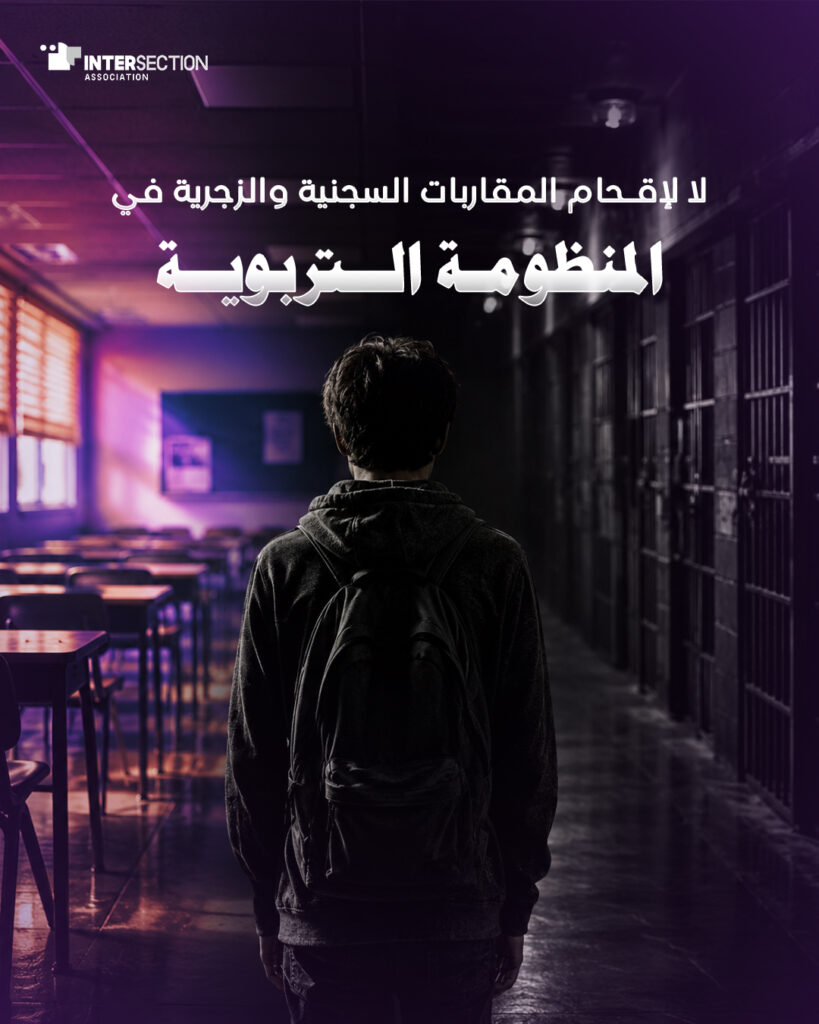
Following the conclusion of the main session of the 2026 baccalaureate exams, amid controversy, arrests, and referrals to the courts involving students accused of cheating, the Intersection Association for Rights and Freedoms stresses that this important national milestone must be followed by a serious review of the policies adopted. Rather than allowing such practices to recur, this moment should serve as an opportunity to draw the necessary lessons and ensure that responses to educational challenges remain consistent with students’ rights and with the purpose of the education system.
While the Association recognizes that protecting the integrity of national exams is a legitimate objective and an essential requirement for ensuring equal opportunities and safeguarding the credibility of national diplomas, it stresses that this objective cannot be achieved by introducing custodial and punitive approaches into the education system, or by treating students through a criminal justice framework that may jeopardize their future and undermine their fundamental rights.
In this context, the Association has been following recent cheating-related cases in national exams, including the arrest of several students and their referral to judicial proceedings before their subsequent release. While the Association reiterates that cheating is unacceptable, as it undermines equal opportunities, weakens trust in the education system, and damages the credibility of national diplomas, it stresses that this phenomenon cannot be addressed through deterrence and punishment alone. Instead, it requires comprehensive educational and preventive approaches that tackle its structural causes, respond to its different motivations, and reduce the conditions that allow it to spread.
The Association considers that resorting to arrest or imprisonment in cases related to cheating in exams reflects a worrying tendency to address educational problems through criminal justice tools. This risks gradually transforming the educational institution from a space for learning, personal development, and citizenship-building into one where security-based approaches take precedence over educational ones. Such measures do not offer real solutions to the phenomenon. They overlook a range of complex factors that contribute to its escalation, including mounting academic pressure, inadequate psychological and social support, growing fears about the future, and the rise of organized cheating networks that exploit the vulnerability of some students and their need to succeed, turning this vulnerability into a market for unlawful profit.
On this basis, the Association affirms that protecting the integrity of national exams remains a collective responsibility shared by families, educational institutions, the State, and society. However, this responsibility cannot justify violating students’ fundamental rights or abandoning the principle of proportionality between the act committed and the sanction imposed. The State is required to protect the credibility and integrity of exams, but it is equally required to protect the right to education, the right to human dignity, and the right to reintegration. These rights must not be held hostage to punitive approaches whose limited effectiveness has been repeatedly demonstrated, and which may leave long-term harmful consequences for individuals and society.
The Association further stresses that what happened during this baccalaureate exam period should serve as the starting point for a comprehensive review of the policies adopted to combat cheating. Such a review must clearly distinguish between organized networks and actors who profit from exploiting students, on the one hand, and the students themselves, on the other, as students are often the more vulnerable party in this equation. Combating organized crime and the trade in cheating tools must remain an absolute priority. At the same time, students’ cases should be addressed through approaches that take into account their age, their social circumstances, and their psychological well-being, while preserving their right to a second chance and to a corrective process that ensures a one-time mistake is not turned into a permanent stigma that threatens their future.
Accordingly, Intersection Association for Rights and Freedoms:
- calls for the adoption of a rights-based and educational approach to cheating cases, grounded in reform, guidance, and awareness-raising rather than arrest and imprisonment;
- calls for guarantees that custodial penalties will not be used in the future in cases involving students within the educational environment, except in the narrowest circumstances required by law and relevant human rights standards;
- stresses the need to strengthen psychological and social support services within educational institutions and to reduce the climate of pressure and fear surrounding national exams;
- calls for structural solutions to reform the assessment and exam system, in a manner that ensures its integrity while protecting students’ rights and dignity;
- calls for a review of relevant laws and policies to uphold the principle of proportionality and prevent educational and pedagogical problems from being transformed into criminal cases with devastating consequences for young people’s futures.
Building a fair education system capable of fostering trust and success cannot be achieved by expanding custodial penalties or broadening punitive powers. It requires deep reforms that address the structural imbalances of the education system, strengthen psychological and social support, ensure equal opportunities and educational justice, and restore the role of the educational institution as a space for learning, empowerment, and personal development.
Prison cannot be the answer to the failures of the education system, nor should it become a tool for addressing phenomena that are, at their core, linked to broader social and educational crises. Protecting the educational institution begins with protecting its educational mission, safeguarding students’ rights, and securing their future within a framework of dignity, justice, and the right to learn.