
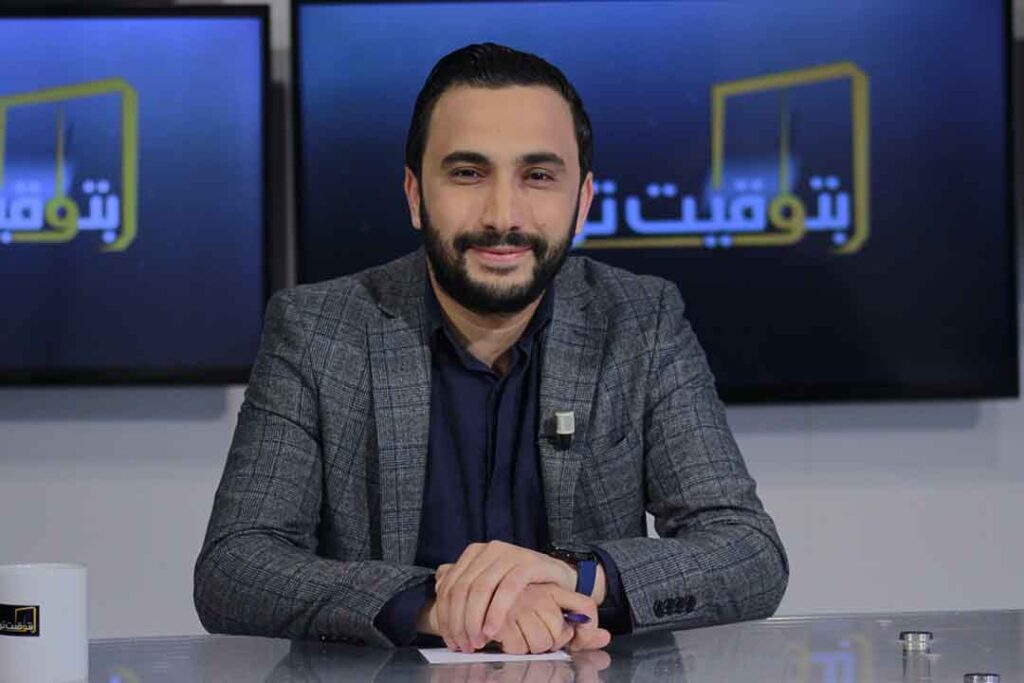
Mohamed Yousfi
Summary
Mohamed Yousfi, a journalist and editor-in-chief of the "Al-Katiba" website, was arrested on 4 September 2026 in connection with a prosecution relating to illicit enrichment, money laundering and forming a criminal association. During his custody, he underwent emergency surgery before a decision committing him to prison was issued on 8 September 2026, in circumstances that, according to the defence team, raised concerns about his health and safety and respect for defence rights and procedural safeguards. He remains in detention at Mornaguia civil prison pending the case.
Personal Information
Name: Mohamed Yousfi.
Nationality: Tunisian.
Status: Journalist, editor-in-chief of the "Al-Katiba" website, and lecturer at the Institute of Press and Information Sciences.
Governorate: Tunis.
Place of detention: Mornaguia civil prison.
Charges: Forming a criminal association with the aim of attacking persons and property, illicit enrichment, and preparing money laundering by an organisation and association, by exploiting the facilities afforded by the characteristics of the position and professional and social activity, under the following legal texts:
- Penal Code: Articles 131 and 132.
- Organic Law No. 26 of 2015 of 7 August 2015 on combating terrorism and preventing money laundering, as amended by Organic Law No. 9 of 2019 of 23 January 2019: Articles 92, 93, 94, 95, 96, 97, 99, 100, 125, 126, 136 and 140.
- Law No. 46 of 2018 of 1 August 2018 on the declaration of assets and interests and on combating illicit enrichment and conflicts of interest: Articles 3, 4, 37, 42, 43 and 45.
Incidents of Violation
Mohamed Yousfi is a Tunisian journalist and editor-in-chief of the "Al-Katiba" website, a news site covering public affairs and political and human rights issues, including freedom of expression and democracy, as well as investigative reporting on corruption cases.
Before his arrest, Yousfi had for some time been subjected to an ongoing campaign on social media in the form of attacks, smear campaigns and targeting because of his journalistic work and positions.
On the evening of Friday 4 September 2026, as Yousfi was preparing to enter the premises of the radio station "Express FM" to take part in a talk show on the water crisis in Tunisia and to present the book "Thirsty Tunisia", a security unit of the National Unit for the Investigation of Complex Financial Crimes arrested him, took his personal phone, and took him to the Third Central Brigade for the Investigation of Complex Financial Crimes of the National Guard in El Aouina, where he was held in custody until the morning of Saturday 5 September 2026.
This followed authorisation by the Public Prosecution on 4 September 2026 to open an investigation, on the basis of what the Prosecution considered to be repeated and concordant information and data indicating suspicions that Yousfi had joined and conspired in an organisation for money laundering by exploiting facilities resulting from his position and professional activity, as well as suspicions of tax evasion and illicit enrichment. The data referred to by the Prosecution was reportedly based on posts and comments circulating on social media about the growth of Yousfi's wealth and the rapid increase of his financial and real estate assets from sources described as unknown.
The defence team, speaking through lawyer Hela Ben Salem, stated that the Public Prosecution's report, as far as she had seen, merely referred to "repeated and concordant information" without explaining how it had been verified, and that the case "was built on a set of conjectures", affirming that there was no banking data proving unusual financial flows, no real estate documents and no financial examinations supporting the charges against him. The defence team considered that Yousfi "is not targeted as a person but for his principled positions and his professional activity".
During the night of his arrest, from the evening of Friday 4 to the early hours of Saturday 5 September 2026, Yousfi suffered an acute health crisis requiring his transfer to hospital, where he underwent emergency surgery to remove his appendix, while still in police custody.
On 7 September 2026, it was decided to extend his custody by a further 48 hours. The National Syndicate of Tunisian Journalists considered this development extremely serious, seriously raising the responsibility of those holding him in custody for his physical and health safety.
On Tuesday 8 September 2026, Yousfi appeared before the investigating judge at the Economic and Financial Judicial Pole to complete his interrogation. The interrogation could not be completed because of the deterioration of his health and the severe pain he was suffering at the site of the surgery, to the point that a Civil Protection doctor had to be called to examine him. According to the defence team, the doctor requested that he be taken to hospital given the seriousness of his condition, while his lawyers went to the pharmacy to buy the necessary medication.
On the same day, a decision was issued committing Yousfi to prison, despite the interrogation not having been completed, according to information provided by the defence team. The team stated that the committal warrant was issued in circumstances it considered to be marred by procedural irregularities, including the failure to complete his interrogation, the failure to allow the defence team to present its arguments, and the issuing of the decision in his absence, in addition to the lawyers' refusal to sign the record.
On 9 September 2026, the administration of Mornaguia civil prison refused to endorse the visiting permit issued by the investigating judge to Yousfi's wife, preventing her from going to the hospital to visit him and bring him his clothes, medication and food.
On the evening of Friday 11 September 2026, the defence team, represented by lawyers Hela Ben Salem and Sami Ben Ghazi, visited Yousfi at Mornaguia prison. Lawyer Hela Ben Salem stated that Yousfi had been transferred from the hospital to the prison on the evening of Thursday 10 September, and that his health was improving and he was recovering.
The lawyer relayed Yousfi's insistence that what he is being subjected to is linked, in his view, to the independent editorial policy of the "Al-Katiba" website and his professional independence, affirming, as reported, that he "has never been an opposition journalist, but an independent journalist doing his job and believing in freedom of the media and the press, and not working according to any agenda or on behalf of any party", and describing what is happening to him as "an attempt at character assassination and an attempt to silence his voice".
As of the preparation of this documentation, Mohamed Yousfi remains in detention at Mornaguia civil prison pending the case.
Human Rights Violations
The documented facts raise serious concerns about possible infringements of a number of fundamental rights and freedoms, in particular freedom of the press and expression, the right to liberty and security of person, defence and fair trial guarantees, the right to humane treatment and health care, the right to communicate with family, and the right to private life and the confidentiality of communications and journalistic sources. With regard to freedom of the press and expression, the available information places the criminal proceedings against Mohamed Yousfi in a context preceded by an ongoing social media campaign targeting him because of his journalistic work and positions, and indicates that he was arrested on his way to take part in a news programme on the water crisis in Tunisia and to present the book "Thirsty Tunisia". The defence team, for its part, states that the case is not based, as far as it has seen, on clear financial, banking or real estate data, and that it considers the prosecution to be linked to his principled positions, his professional activity and the independence of the editorial line of the "Al-Katiba" website. Article 37 of the 2022 Constitution of the Tunisian Republic protects freedom of opinion, thought, expression, information and publication, Article 38 enshrines the right to information and access to information, and Article 55 subjects restrictions on rights and freedoms to the principles of legality, necessity and proportionality and to not undermining the essence of the right. Article 19 of the International Covenant on Civil and Political Rights also protects freedom of opinion and expression, including seeking, receiving and imparting information and ideas, and Article 9 of the African Charter on Human and Peoples' Rights enshrines the right to receive information and to express and disseminate opinions. At the national level, Decree-Law No. 115 of 2011 on freedom of the press, printing and publishing guarantees freedom of expression and the circulation and publication of ideas and information; its Article 11 protects the confidentiality of journalists' sources, Article 12 prohibits the opinions or information published by a journalist from being used as a pretext to undermine their dignity or physical or moral integrity, and Article 13 does not permit a journalist to be held accountable for an opinion, idea or information published in accordance with the customs and ethics of the profession except where a breach of the provisions of the Decree-Law is established. If it is established that journalistic activity or editorial positions were the direct cause of or a pretext for the prosecution, or that criminal proceedings were used to restrict the legitimate exercise of freedom of expression, this may constitute an unlawful restriction on freedom of the press and expression, particularly if it does not meet the conditions of legality, necessity and proportionality.
As regards the right to liberty and security of person, Article 26 of the 2022 Constitution guarantees individual liberty, and Article 35 provides that no person may be arrested or held in custody except in cases of flagrante delicto or by judicial decision, and that they must be informed immediately of their rights and the charge against them, with their right to a lawyer guaranteed; the duration of arrest and custody is set by law. Article 9 of the International Covenant on Civil and Political Rights guarantees the right to liberty and security of person and prohibits arbitrary arrest or detention, and Article 6 of the African Charter also protects the right to liberty and security. This issue takes on additional importance given that his custody was extended on 7 September, in a context in which he had previously undergone emergency surgery, requiring verification of whether legal and health safeguards were respected throughout the custody period.
As regards defence and fair trial guarantees, the facts relating to the interrogation session of 8 September 2026 raise a serious issue requiring verification of whether the procedures prescribed by law were respected. According to the defence team, Yousfi's interrogation was not completed because of his health condition, the defence team was not allowed to present its arguments, the committal decision was issued in his absence, and the lawyers refused to sign the interrogation record. Article 33 of the 2022 Constitution of the Tunisian Republic enshrines the presumption of innocence and guarantees the accused a fair trial with all the guarantees necessary for the defence, Article 35 enshrines the right to a lawyer, Article 14 of the International Covenant on Civil and Political Rights guarantees fair trial and defence rights, and Article 7 of the African Charter on Human and Peoples' Rights protects the rights of the defence. Article 69 of the Code of Criminal Procedure is relevant in this case given the safeguards surrounding appearance and interrogation before the investigating judge, while Article 80 of the Code provides for the possibility of issuing a committal warrant after the suspect has been interrogated and after obtaining the opinion of the Public Prosecutor. Accordingly, the defence team's statement that the committal warrant was issued before the interrogation was completed raises a serious procedural issue.
Mohamed Yousfi's health condition also raises concerns about respect for his physical integrity and his right to appropriate health care during custody, given that he underwent emergency surgery while in custody and then suffered severe pain and a deterioration in his health during his interrogation on 8 September, to the point that he had to be examined by a Civil Protection doctor, who, according to the defence team, requested his transfer to hospital. Article 25 of the 2022 Constitution protects human dignity and bodily integrity and prohibits psychological and physical torture, and Article 36 guarantees every person deprived of their liberty humane treatment that preserves their dignity. Article 10 of the International Covenant on Civil and Political Rights guarantees that persons deprived of their liberty are treated with humanity and respect for the inherent dignity of the human person, Article 7 prohibits cruel, inhuman or degrading treatment, and Article 5 of the African Charter protects dignity and physical and moral integrity. The Code of Criminal Procedure also contains safeguards relating to medical examination during police custody.
The refusal by the administration of Mornaguia civil prison on 9 September 2026 to endorse the visiting permit issued by the investigating judge to Yousfi's wife raises the question of respect for the right of a person deprived of their liberty to maintain family ties, particularly given that the visit was, according to the available information, based on an authorisation issued by the investigating judge, and that the refusal prevented his wife from visiting him and bringing him his clothes, medication and food. Article 36 of the 2022 Constitution, in the context of the execution of custodial sentences, enshrines the state's obligation to take the interests of the family into account, and international standards on the treatment of persons deprived of their liberty recognise the importance of maintaining contact with family. Accordingly, refusing to implement a judicial visiting authorisation constitutes an infringement of Yousfi's right to maintain his family ties and of the safeguards relating to his conditions of detention.
As regards the phone seized during Yousfi's arrest, the incident raises two separate legal issues: the lawfulness of seizing the device itself, and the lawfulness of accessing its content and using the data on it. Article 30 of the 2022 Constitution of the Tunisian Republic protects private life and the confidentiality of correspondence, communications and personal data, and Article 11 of Decree-Law No. 115 of 2011 protects the confidentiality of journalists' sources, considering investigations, searches or interception of correspondence and communications aimed at uncovering a journalist's sources to be violations of source confidentiality.