
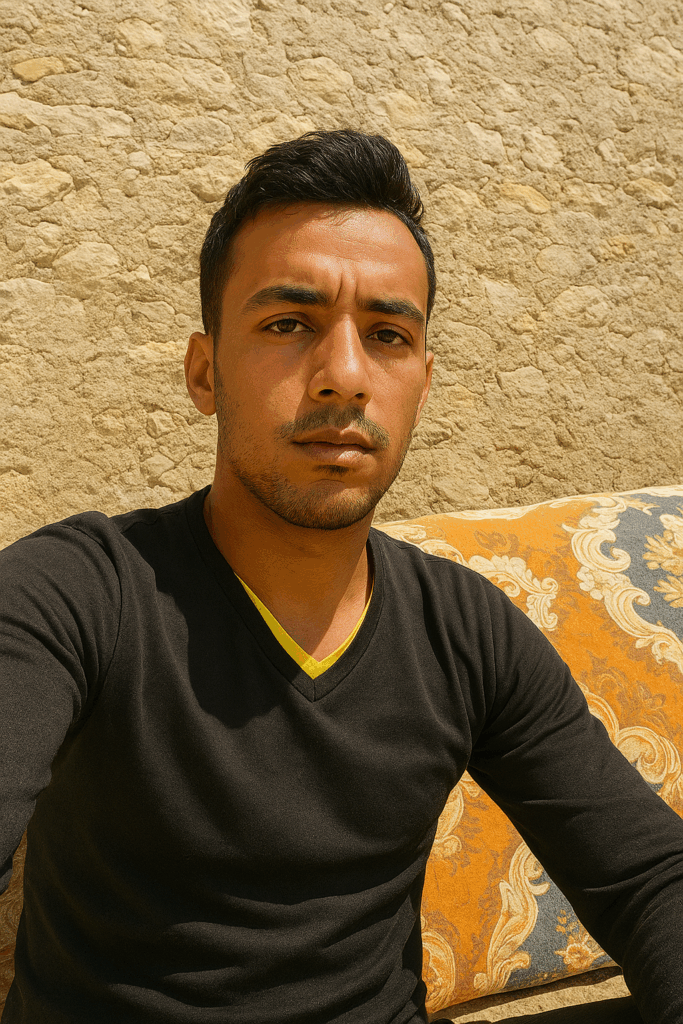
Akrem Jamaoui
أكرم الجمعاوي - Akrem Jamaoui
Summary
Akrem Jamaoui, a 25-year-old young man from the governorate of El Kef, was suddenly arrested on 1 June 2024 while returning home after watching a football match. He was taken to Mornaguia Prison, where he was subjected to violence within its walls; his family was then informed of his death in suspicious circumstances, without any explanation being provided.
Personal Information
- First name: Akrem
- Surname: Jamaoui
- Age: 25
- Nationality: Tunisian
Incidents of Violation
On 1 June 2024, Akrem Jamaoui attended a football match at Rades Stadium between Club Africain and Espérance Sportive de Tunis. Following violence that broke out outside the stadium, he was arrested right at the stadium walls and taken to the Sidi El Bechir security post without his family being informed, held in custody and then transferred to the Bouchouchah detention centre. Three days after his arrest, a committal warrant was issued against him and he was transferred to Mornaguia Civil Prison.
His family stated that during that whole period they did not receive any official information about his whereabouts or his health condition, despite their repeated attempts to inquire and search for him. They added that the Sidi El Bechir post initially denied any knowledge of him or of his arrest. Family members said they lived in anxiety and confusion because of the lack of contact with their son, which led them to turn to social media and post an appeal on Facebook in an attempt to find any information about him. As soon as the appeal was published, a person who had been detained at the Bouchouchah detention centre at the same time as Akrem contacted them and told them he had seen him there. When they went to that centre, they were informed that Akrem was in Mornaguia Civil Prison. The family adds that a few days after he was imprisoned, Akrem was convicted and sentenced to one year in prison.
Akrem was present at his trial, and the family reported that he did not appear to be in a good state. He told the judge that he was being beaten, mentioning that he felt ill and that his health was deteriorating. His father added that during a visit Akrem told him he had been beaten and mistreated in prison, saying: “Dad, they’re going to kill me. Look, things have turned against me, look, no.”
Two weeks into his imprisonment, on 17 June, Akrem Jamaoui died in Mornaguia Prison at midday; he was taken to Charles Nicolle Hospital in Tunis, and the family was informed of his death that evening. The family recounted that they were told the cause of death was respiratory distress and cardiac arrest. However, they denied that Akrem suffered from any chronic illness, stressing that he had entered prison in good health and that his health began to deteriorate because of the prison conditions. After a forensic examination, the report stated that the death resulted from a severe violent assault with a hard object, which caused a complete fracture of the rib cage and internal bleeding.
Since Akrem's death, the family has written to various bodies and authorities seeking intervention and justice, stating that their son died in mysterious circumstances and was a victim of violence, in the hope of obtaining his rights and holding the perpetrators accountable. A judicial investigation was opened into the matter, but no action has been taken.
Human Rights Violations
The case of Akrem Jamaoui involves several serious human rights violations affecting his dignity, his right to life and bodily integrity, and the guarantees of a fair trial. He was arrested without his family being informed and without being allowed to exercise his right to contact them or a lawyer, which constituted a clear breach of every person's right to know the reasons for their arrest and to have their relatives informed of their place of detention. This measure contravenes Law No. 5 of 2016, which provides for every detainee's right to know the reasons for their arrest, to have their family informed and to contact a lawyer. It also violates Article 9 of the International Covenant on Civil and Political Rights, which prohibits arbitrary detention and requires that detainees be informed of the reasons for their arrest, as well as Article 6 of the Universal Declaration of Human Rights, which enshrines everyone's right to recognition as a person before the law. Akrem should therefore have enjoyed all his legal rights, and what happened to him may be considered a case of arbitrary detention and temporary enforced disappearance.
Moreover, Akrem was subjected to beatings and ill-treatment in prison, as later confirmed by the forensic report, which established that the death resulted from a severe violent assault with a hard object causing a complete fracture of the rib cage and internal bleeding. These facts constitute a flagrant breach of Article 25 of the Constitution, which states that “The State protects human dignity and the integrity of the body and prohibits moral and physical torture; the crime of torture is not subject to any statute of limitations.” In addition, Organic Law No. 43 of 2013 on the prevention of torture obliges the State to investigate promptly every allegation of torture. What Akrem endured also violates Article 5 of the Universal Declaration of Human Rights and Article 7 of the International Covenant on Civil and Political Rights, which both prohibit torture and cruel, inhuman or degrading treatment, and constitutes an explicit violation of the provisions of the Convention against Torture.
Akrem's death in Mornaguia Civil Prison as a result of a violent assault constitutes a violation of the right to life and bodily integrity, a sacred right guaranteed by Article 24 of the Constitution, which states that “The right to life is sacred and may not be infringed except in extreme cases regulated by law”, by Article 3 of the Universal Declaration of Human Rights, which states that “Everyone has the right to life, liberty and security of person”, and by Article 6 of the International Covenant on Civil and Political Rights, which obliges States to protect the right to life and not to deprive anyone of it arbitrarily. The Standard Minimum Rules for the Treatment of Prisoners (the Mandela Rules) also place full responsibility on the State for the life and safety of every person in its custody, including persons deprived of their liberty.
Article 10 of the International Covenant on Civil and Political Rights affirms that “All persons deprived of their liberty shall be treated with humanity and with respect for the inherent dignity of the human person”, and the Mandela Rules oblige prison institutions to provide health care equivalent to that available outside prison.
Akrem's death is not an isolated or unique case, but part of a recurring pattern of violations and a series of deaths in prisons, which calls for a serious investigation into cases of suspicious death, genuine national accountability, and an urgent review of the prison system and legal procedures, so as to guarantee the protection of the rights to life, dignity and health.