
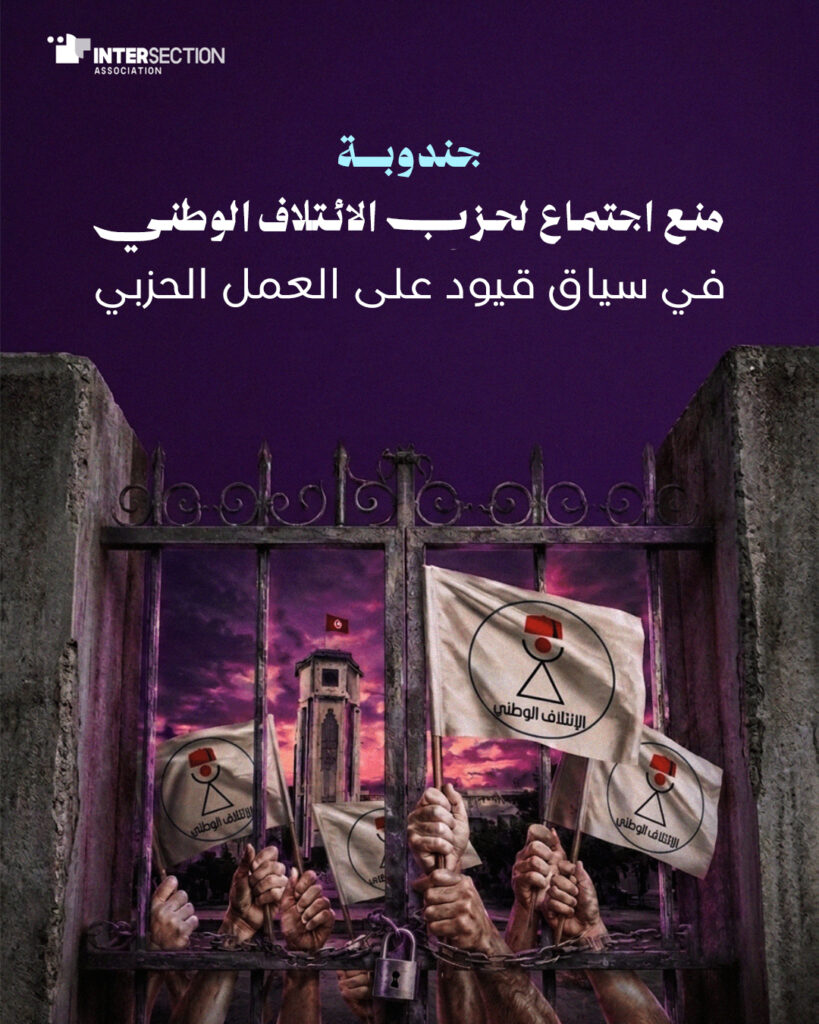
Jendouba: National Coalition Party Meeting Banned Amid Restrictions on Party Activity
Summary
The National Coalition Party, a Tunisian political party founded in August 2020 and led by former Minister of Education Dr Neji Jalloul, was prevented from holding a party meeting scheduled for 5 July 2026 at a private venue in the governorate of Jendouba, according to party officials. The available information indicates that the party had notified the regional authorities in advance of the meeting, but the local authorities informed it that it could not be held as a party activity. Testimonies also indicate that security officers intervened to prevent the meeting from taking place, monitored the participants, prevented them from entering other venues within the governorate and followed them to the border of the governorate of Beja. The party intends to challenge the ban before the administrative courts, considering that it undermines its right to engage in political activity.
General Information
Entity: National Coalition Party.
Status: A centrist social-democratic Tunisian political party, founded in August 2020.
Nature of the violation: Banning the party's meeting at a private venue in the governorate of Jendouba.
Incidents of Violation
As part of the National Coalition Party's periodic meetings in the various governorates of the Republic, a meeting was scheduled for 5 July 2026 at a private venue in the governorate of Jendouba. According to party officials, the party's leadership informed the local authorities and wrote to the governorate of Jendouba about the date and venue of the meeting 48 hours in advance.
According to the party's secretary-general, the local authorities informed the party on the eve of the meeting that the activity could not be held as a party meeting, while informing it that the same people could meet at the same venue as citizens, but not as members of the party.
The information indicates that on the scheduled day, party members travelled to the governorate of Jendouba to hold the meeting, but were surprised when the owner of the private venue informed them that he could not host them, after receiving, according to his account, instructions from the regional authorities.
Testimonies also indicate that security officers intervened before the meeting began and prevented it from being held, monitored the participants, and prevented them from entering other venues within the governorate, including some archaeological sites. Accounts further indicate that the officers followed the participants to the border of the governorate of Beja, which, according to the party's secretary-general, prevented them from continuing the remaining activities that had been scheduled before their return to Tunis.
According to the party president, the regional authorities in the governorate of Jendouba were asked about the reasons for banning the meeting and the accompanying measures, and they stated that the content of the letter addressed to them was not sufficiently clear to allow the meeting to be held.
The party's secretary-general added that the party considers what happened to be an infringement of its right to hold meetings and engage in political activity, and stated that the party intends to take the necessary legal action, including filing a case before the Administrative Court to challenge the decision issued by the governorate of Jendouba.
Human Rights Violations
The documented facts reveal restrictions on the National Coalition Party's exercise of its political activity, raising human rights issues relating to freedom of peaceful assembly, freedom to form parties and engage in political activity, and freedom of movement, in light of the guarantees provided by the Tunisian Constitution and international and regional human rights treaties. The information indicates that the party notified the local authorities in advance of the date and venue of the meeting, before being informed that it could not be organised as a party activity, and that the authorities intervened, according to testimonies, to prevent the meeting from being held in the private venue designated for it. This raises questions as to whether the right to freedom of peaceful assembly was respected, as guaranteed by Article 40 of the 2022 Constitution of the Tunisian Republic and Article 21 of the International Covenant on Civil and Political Rights, which permits restrictions on this right only if they are prescribed by law, necessary in a democratic society and proportionate to a legitimate aim, as affirmed by the Human Rights Committee in its General Comment No. 37.
The facts also raise issues relating to freedom to form parties and engage in political activity, since Article 42 of the Constitution, Article 22 of the International Covenant on Civil and Political Rights and Article 10 of the African Charter on Human and Peoples' Rights all guarantee freedom to form associations and parties and to carry out their activities without unjustified restrictions. Testimonies regarding the monitoring of participants, preventing them from entering other venues within the governorate, and following them to the border of the governorate of Beja raise further questions as to whether freedom of movement, guaranteed by Article 30 of the Constitution and Article 12 of the International Covenant on Civil and Political Rights, was respected.
From the perspective of administrative law, these facts also raise issues as to whether the ban was based on a clear legal basis, met the requirement to state reasons, and respected the principle of proportionality between the measure taken and its intended aim, which are essential guarantees of the lawfulness of administrative decisions, particularly when they result in restrictions on the exercise of fundamental rights and freedoms. If the facts attributed to the local authorities are established, they may be incompatible with the principles of legality, necessity and proportionality that govern restrictions on rights under international human rights law, which may affect the party's exercise of its right to peaceful assembly, political organisation and participation in public life.
Intersection Association for Rights and Freedoms calls on the Tunisian authorities to guarantee respect for freedom of peaceful assembly and party activity, to refrain from imposing any restrictions on the activities of political parties except in accordance with the limits required by law and consistent with the principles of legality, necessity and proportionality, and to ensure that administrative decisions restricting rights and freedoms are subject to effective judicial review guaranteeing remedies for those affected.