
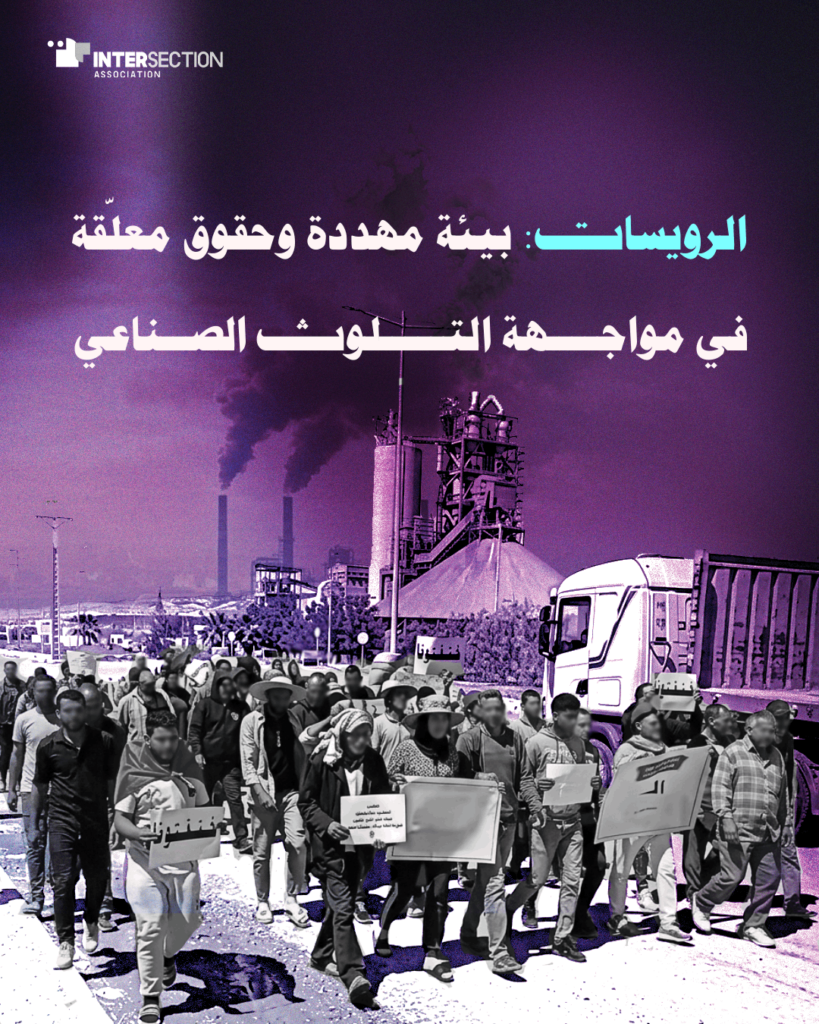
Rouissat: A Threatened Environment and Suspended Rights in the Face of Industrial Pollution
Summary
Since 2014, the area of Rouissat in the delegation of Chbika, Kairouan governorate, has been experiencing a deteriorating environmental and social situation linked to the activity of a cement plant and the resulting emissions and industrial dust, as well as the use of petroleum coke and blasting operations in its quarries. Testimonies indicate damage to farmland, homes and educational facilities, as well as potential effects on residents' health and on natural resources. This situation led to successive protests since 2014, followed by prosecutions and arrests targeting a number of protesters, before the actions were renewed in 2020 and then resumed in 2026 through an open-ended sit-in since 25 April, demanding the right to a healthy environment, the protection of property and farmland from pollution, reparation for the damage and solutions to the issue.
Information on the Victims of the Violation
Group: Residents of the Rouissat area, including families who depend on farming, children and pupils of the Fej Rouissat primary school, and owners of homes, land and facilities near the plant.
Governorate: Kairouan.
Nature of the violations: Violation of environmental, health, social and educational rights and children's rights, and potential damage to property and facilities, in addition to restrictions imposed on the exercise of the right to peaceful assembly and demonstration.
Incidents of Violation
Since 2014, the area of Rouissat in the delegation of Chbika, Kairouan governorate, has seen repeated complaints from residents about environmental, health and social effects that they attribute to the activity of the "Sotacib Kairouan" cement plant. Residents point to the persistence of this situation over the years and its repercussions on the residential and agricultural areas surrounding the plant.
The main complaints concern the spread of industrial dust and emissions from the plant's activity, particularly after petroleum coke was adopted in the production process. Residents say that storing this material in open spaces contributed to the spread of dust and suspended particles in the surroundings and led, according to their accounts, to a deterioration in air quality in the neighbouring residential and agricultural areas. Rouissat residents also point to damage to soil and farmland, particularly land close to the plant, and speak of damage to a number of crops, including olives and cereals, a decline in the fertility of some land and effects on vegetation cover.
In addition, based on the available testimonies, their complaints include damage to livestock, water sources and natural resources. They consider that the continuation of the reported environmental effects may affect farming, which is a main source of income for a number of families, and limit their ability to benefit from their agricultural resources and property.
Furthermore, a number of residents complain of recurring symptoms and health problems, including coughing, shortness of breath, allergies, eye and skin irritation and respiratory disorders. They also express particular concern about the potential effects of these conditions on children, the elderly, pregnant women and other people who may be more vulnerable to the health risks associated with pollution.
Residents' complaints are not limited to environmental and health aspects but extend, according to their accounts, to material damage to a number of homes and facilities near the plant and its quarries. A number of residents reported the appearance of cracks and fissures in the walls and roofs of some buildings, attributing this to vibrations caused by repeated blasting operations in the quarries operated by the plant. The accounts also include damage to a number of public and educational facilities close to the areas of activity and blasting. Among the facilities reported to have been damaged, according to what was documented, is the building of the Fej Rouissat primary school, where cracks and damage to parts of its structure were observed, raising concerns about the safety of pupils and teaching staff, particularly given the school's proximity to the areas of activity and blasting.
The available testimonies state that the plant's management usually contacts the school administration before starting quarry blasting operations, to inform it that pupils must be taken out of the classrooms while the blasting is carried out. These testimonies indicate that blasting operations cause repeated vibrations whose effects extend to homes near the quarries, which has led a number of residents to demand an audit and an independent study to determine the levels of these vibrations, assess their danger and identify the potential damage they cause.
According to the information provided, protest actions in the area date back to 2014, before being renewed in 2020 and then returning in 2026 because of the ongoing environmental and health situation. According to the information provided, a number of Rouissat residents began an open-ended sit-in in front of the cement plant on 25 April 2026 to demand that the authorities intervene, put an end to pollution and protect the residents, the environment, property and farmland. Since the start of the sit-in, actions and contacts between residents and the regional authorities have continued in an effort to reach solutions to the demands relating to the environmental and social effects associated with the plant's activity.
On 9 May 2026, a meeting was held between representatives of Rouissat residents and the regional authority, but they boycotted the meeting and withdrew from it, according to their accounts, in protest at the absence of a representative of the plant, which they considered an essential party to the negotiations, as the entity directly concerned by the activity complained of. On 12 May 2026, parents of pupils at the Fej Rouissat primary school held a protest in front of the school, demanding that the necessary measures be taken to protect their children and to rehabilitate the school's infrastructure, as well as a solution to the blasting operations, which they consider have become a danger to the surrounding homes and institutions. On 18 May 2026, a protest march set off from the sit-in tent towards Carthage Palace to demand the intervention of the central authorities and work towards solutions to the demands raised.
According to the available information, the march was stopped in the delegation of Kondar, before a meeting was held with the governor of the region, attended by a number of residents and representatives of the Tunisian Forum for Economic and Social Rights. During this meeting, according to the information provided, a commitment was made to hold further meetings bringing together the various parties concerned with the issue, with a view to reaching an agreement and fair solutions to the residents' demands.
On 3 June 2026, another meeting was held at the headquarters of the delegation of Chbika, attended by a number of regional directors, representatives of the regional authority, local members of parliament, representatives of the residents and a representative of the Tunisian Forum for Economic and Social Rights.
During the meeting, the residents' representatives presented a list of their demands, arranged by area and priority, with a particular focus on environmental and health demands and on the need to address the effects of industrial activity and blasting operations. The issue of the damage to homes, land and educational institutions was also raised, together with a demand for independent inspections and expert assessments to determine the extent of the damage and responsibilities.
On 17 June 2026, protest actions continued with a protest in front of the headquarters of the Ministry of Environment, where residents called for urgent intervention by the central authorities to address the environmental and health situation in the area.
According to the available information, the negotiation meetings and protest actions had not, as of the date of documentation, led to a final resolution of the issue. Nor have residents, according to their accounts, seen any comprehensive intervention to repair the damage to homes, facilities and land, or a clear programme to protect residents from potential environmental and health risks.
The residents of Rouissat are calling for an independent and comprehensive assessment of the environmental, health and structural situation in the area, including measurement of air quality, analysis of soil and water quality, research into the extent of the impact of emissions on citizens' health and on crops, and an engineering assessment of the damaged homes, school and facilities.
They are also calling for verification of the extent to which the plant complies with the laws and regulations on classified industrial activities, in particular the conditions for the storage and use of hazardous materials, the conditions for quarry operation, the rules governing blasting operations, and the extent to which safety distances from residential areas and educational institutions are respected. The nature of the plant's industrial activity raises the question of the extent to which it complies with the legal and regulatory frameworks governing industrial establishments and activities that may affect health, the environment and public safety.
Human Rights Violations
The documented facts, according to residents' accounts, point to suspected violations of a number of rights relating to health, the environment, physical integrity, property and a decent life, as well as children's rights, the right of access to information and the right to peaceful assembly and demonstration.
Article 47 of the 2022 Constitution of the Tunisian Republic protects the right to a healthy and balanced environment and obliges the state to provide the means to eliminate environmental pollution. Article 43 recognises the right to health and obliges the state to guarantee prevention and health care and to provide the resources necessary to ensure safety and the quality of health services. This protection is consistent with Article 24 of the African Charter on Human and Peoples' Rights, which recognises the right of peoples to a general satisfactory environment favourable to their development.
In this context, the persistence of complaints about emissions, dust and the pollution of air, soil and water, if established, raises the question of the extent to which the state is fulfilling its obligations to prevent pollution and to monitor industrial activities that may affect the health of residents and the environment. Moreover, the right to health is not limited to treatment, but includes the underlying determinants of health and the environmental and health conditions in which individuals live, according to the interpretation by the Committee on Economic, Social and Cultural Rights of Article 12 of the International Covenant on Economic, Social and Cultural Rights.
The health harms that residents say they are inevitably exposed to, including breathing difficulties, allergies and eye and skin irritation, raise suspicions of an infringement of the right to health; however, establishing a link between these symptoms and the emissions attributed to the plant requires independent medical and environmental examinations and data. The failure to carry out an independent assessment of the health and environmental situation, despite the persistence of complaints, is therefore an element that requires follow-up and verification of whether the competent authorities have fulfilled their duties of prevention and monitoring.
The reported damage to homes, facilities and farmland also raises the question of the right to property and physical integrity. Article 29 of the 2022 Constitution guarantees the right to property and permits its restriction only in the cases and with the guarantees laid down by law, while Article 25 protects human dignity and physical integrity, and Article 24 enshrines the right to life.
If the cracks and damage to homes, the school and facilities are shown to be linked to the vibrations caused by blasting operations, the failure to take measures to prevent or limit the damage, or the failure to determine responsibilities and repair the damage, may raise issues relating to the protection of property and safety.
The situation of the Fej Rouissat primary school is of particular importance given the presence of children and pupils in the vicinity of industrial activity and blasting operations. Article 52 of the 2022 Constitution of the Tunisian Republic guarantees the rights of the child, including dignity, health, care, upbringing and education, and obliges the state to provide all forms of protection to children without discrimination and in accordance with the best interests of the child. Article 44 guarantees the right to free public education, obliging the state to strive to provide the resources necessary to achieve quality in education, teaching and training.
Accordingly, concerns about the safety of the school and the pupils, if technically confirmed, require appropriate preventive measures, including an assessment of the safety of the institution and its surroundings and verification of the impact of blasting operations on it, taking into account the best interests of the child in all measures taken.
The reported damage to farmland, crops and water sources is also linked to the ability to farm and secure a livelihood. Article 46 of the Constitution guarantees the right to work, and Article 47 guarantees the right to a healthy and balanced environment. If it is established that pollution or other damage attributed to the industrial activity has destroyed crops, degraded land or affected the natural resources on which residents depend, this may directly undermine their ability to benefit from their sources of livelihood and carry out their farming activity.
This issue is also linked to the right to an adequate standard of living enshrined in Article 11 of the International Covenant on Economic, Social and Cultural Rights, and to the right to health enshrined in Article 12 thereof, given the interconnection between housing conditions, the environment, water, health and livelihoods.
On the other hand, the stopping of the march organised by residents on 18 May 2026 raises the question of respect for the right to peaceful assembly and demonstration, guaranteed by Article 42 of the 2022 Constitution of the Tunisian Republic. Residents' right to participate effectively in addressing the environmental situation is also linked to their right of access to relevant information. Article 38 of the 2022 Constitution guarantees the right to information and the right of access to information.
In the context of this case, this includes providing residents with available data on emissions, environmental risks and the results of inspections, studies and monitoring relating to the industrial activity. The African Commission on Human and Peoples' Rights, in its 2026 resolution on access to information and the right to a healthy environment, also affirmed the link between the right to information, environmental protection and the right to health.
As regards responsibility, the documented facts attribute the source of the environmental damage complained of to the activity of the "Sotacib Kairouan" plant, according to residents' testimonies, while the competent authorities bear responsibilities relating to monitoring, prevention, protection of residents and enforcement of the relevant environmental, health and safety legislation.
Hazardous, unhealthy or nuisance-causing establishments in Tunisia are subject to a specific legal and regulatory framework, including the Order of the Minister of Industry, Energy and Small and Medium Enterprises of 15 November 2005 establishing the list of these establishments, which classifies cement manufacturing and certain related materials among the activities subject to a special regime of monitoring and safety. Quarrying activities and blasting operations are also subject to legal and regulatory frameworks and technical conditions relating to safety and the protection of people and surrounding facilities, in addition to Decree No. 2687 of 2006 on the procedures for opening and operating these establishments. Subsequent regulatory texts also refer to a regime of environmental impact assessment for certain units and activities.
Accordingly, the persistence of residents' complaints requires verification of the extent to which the plant complies with the legal and regulatory requirements applicable to its activity, particularly with regard to emissions, the materials used and their storage, quarry operation, blasting operations and safety in the vicinity of residential areas and educational institutions. It also requires providing residents with the relevant information, carrying out independent and transparent assessments of the environmental, health and structural situation, determining the causes of the reported damage and the responsibilities of the parties concerned, and ensuring reparation for the damage once responsibility is established.