
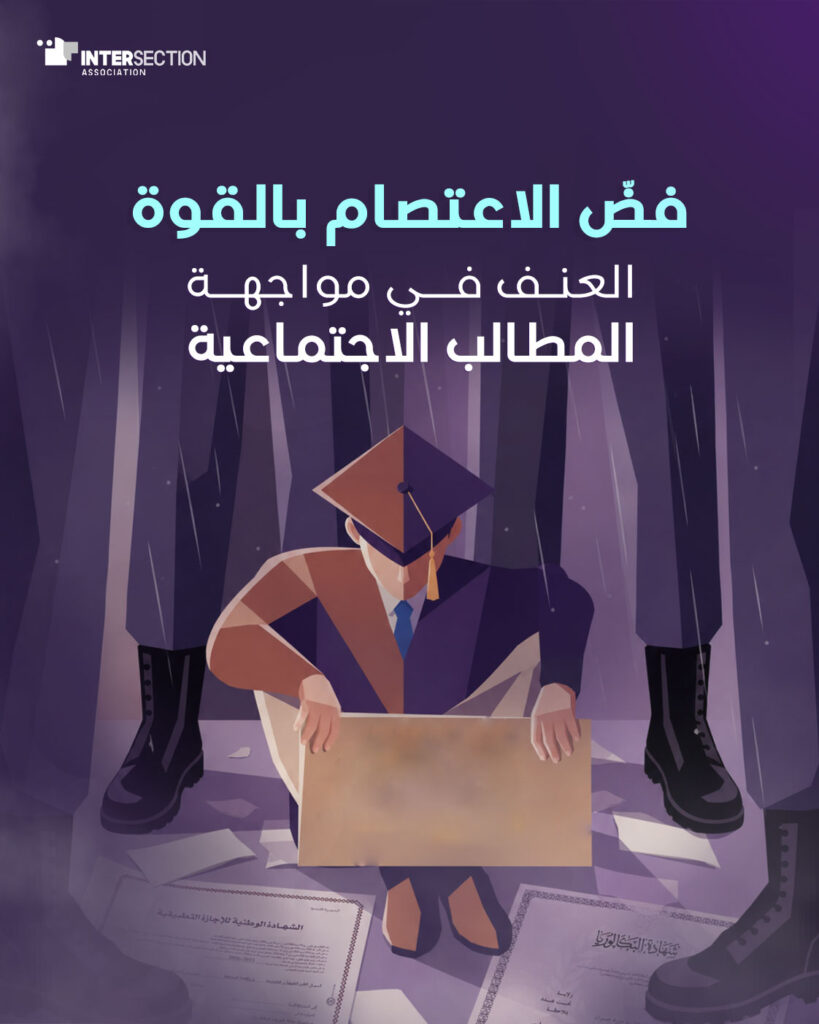
Sit-in Dispersed by Force: Violence in Response to Social Demands
Summary
On 1 September 2026, a number of unemployed graduates held a peaceful sit-in in Kasbah Square demanding the implementation of Law No. 18, the issuance of its implementing decrees, the creation of the online platform and the start of recruitment, before security units intervened using violence to disperse the protesters and arrested several of them, including Mohamed Feridhi, Hassouna Gafsi and Imed Sliti, who were later released. Following this, the protesters began an open-ended sit-in in front of the Municipal Theatre in Tunis, where the night saw a security escalation that ended at dawn the next day with the protesters being forced to leave the site, with the use of physical and verbal violence, according to the available testimonies.
General Information
Group: Unemployed holders of higher education degrees
Governorate: Tunis
Nature of the violation: Use of violence against protesters while dispersing the sit-in, and arrest of a number of participants.
Incidents of Violation
As part of their ongoing actions demanding the activation of Law No. 18 on the recruitment of unemployed graduates and the implementation of its provisions, protest actions continued to demand the issuance of the implementing decrees, the creation of the online platform and the start of recruitment.
In the context of these actions, a peaceful sit-in began in Kasbah Square on 1 September 2026 at 10:00 a.m., in which a number of unemployed graduates took part. According to the available information, the sit-in proceeded under normal conditions before security units intervened to disperse the protesters using violence and arrested several of them, including Mohamed Feridhi, Hassouna Gafsi and Imed Sliti, who were later released.
Following this, the protesters decided to begin an open-ended sit-in in front of the Municipal Theatre in Tunis. At around 10:30 p.m., senior security officers approached a number of the protesters and invited them to talk, then asked them to leave the site, on the grounds that the scene could harm Tunisia's image abroad. However, they refused to leave, affirming their determination to continue the sit-in until their demands were met.
The senior security officers later returned with a softer tone: a short video was filmed with a number of the protesters about their demands, with an indication that it would be sent to the President of the Republic. It was also proposed to hold a meeting on the morning of 2 September 2026 to set deadlines for meeting the demands, and the protesters were informed, according to the available testimony, that they could remain on site and continue the sit-in without harassment until the meeting was held.
However, at around 01:00 a.m. on 2 September 2026, large security reinforcements arrived at the sit-in site, and the protesters were forced to leave, with the use of physical and verbal violence. The testimony stated that some of the women protesters were asleep during the intervention and were woken by being kicked, and that, according to the same testimony, a number of protesters were dragged from the top of the theatre steps to the bottom, and the protesters were pushed to leave the site under police escort.
Afterwards, the protesters were taken to the Bab Alioua bus station, with security units remaining in the vicinity and monitoring their departure, according to the available information.
Human Rights Violations
If established, these facts affect a number of fundamental rights and freedoms, foremost among them the right to peaceful assembly and demonstration, the right to bodily integrity and human dignity, and the right to liberty and security, in addition to the link between the documented protest and the demand for the right to work. Article 42 of the Constitution of the Tunisian Republic guarantees freedom of peaceful assembly and demonstration, and Article 37 guarantees freedom of opinion, thought, expression, information and publication. At the international level, Article 21 of the International Covenant on Civil and Political Rights protects the right of peaceful assembly and permits restrictions on it only in accordance with the conditions set out in the Covenant, including that restrictions be necessary and proportionate to a legitimate aim.
The human rights assessment in this case is not limited to the principle of intervening to disperse the sit-in, but also covers the manner in which it was carried out. According to the available testimony, the intervention included kicking some women protesters while they slept and dragging a number of protesters from the top of the theatre steps to the bottom, in addition to the use of physical and verbal violence. If established, these acts may constitute an infringement of bodily integrity and human dignity, rights protected by Article 25 of the Constitution, which prohibits psychological and physical torture, while Article 7 of the International Covenant on Civil and Political Rights prohibits torture and cruel, inhuman or degrading treatment or punishment.
Any restrictions imposed on the exercise of rights and freedoms are also subject to the conditions set out in Article 55 of the Constitution, which requires that restrictions be established by law, be required by a democratic order, and aim to protect the rights of others or the requirements of public security, national defence or public health, that they not undermine the essence of rights and freedoms, and that they be proportionate to their justifications. Accordingly, the lawfulness of the security intervention does not exempt the authorities from the obligation to respect physical integrity and dignity, nor from demonstrating the necessity of any use of force and its proportionality to the prevailing circumstances.
The arrests of a number of protesters also raise the question of respect for the right to liberty and security. Article 35 of the Constitution provides that no person may be arrested or detained except in cases of flagrante delicto or by judicial decision, and that they must be informed immediately of their rights and of the charge against them, and be allowed to have a lawyer. Article 9 of the International Covenant on Civil and Political Rights also prohibits arbitrary arrest or detention.
The subject of the sit-in is also linked to the right to work, as Article 46 of the Constitution of the Tunisian Republic provides that work is a right of every citizen, and that the state takes the necessary measures to guarantee it on the basis of competence and fairness, while guaranteeing the right to work in decent conditions and for a fair wage. Moreover, graduates' demands for their social and economic rights through peaceful means fall within the exercise of their legally guaranteed rights and freedoms, requiring the authorities to respect and protect this exercise.
The facts take on additional significance given that the available information indicates that an initial security intervention was followed by dialogue with a number of protesters, a proposal to hold a meeting the following morning, and an assurance that the sit-in could continue until then, before a further security intervention took place at around one o'clock in the morning on 2 September 2026. If established, these circumstances raise questions about the necessity and proportionality of the intervention and the extent to which the situation could have been addressed by proportionate means, including continued dialogue, although the current information alone does not allow a definitive conclusion that the intervention was unlawful.
Accordingly, the allegations regarding the use of physical and verbal violence, in particular kicking and dragging, require verification and investigation, including determining the circumstances of the intervention and the bodies and individuals responsible for it, the proportionality of the means used to the prevailing circumstances, and the determination of responsibilities where any abuses are established. The circumstances of the arrests of a number of protesters, and the extent to which legal safeguards were respected during them, must also be verified.
Intersection Association for Rights and Freedoms affirms that exercising the right to peaceful protest and demanding social and economic rights should not be a reason to expose protesters to violence, humiliation or arbitrary arrest, and that protecting the right to peaceful assembly and demonstration requires the authorities to respect the dignity and physical integrity of participants and to guarantee the exercise of these rights without fear or intimidation.