
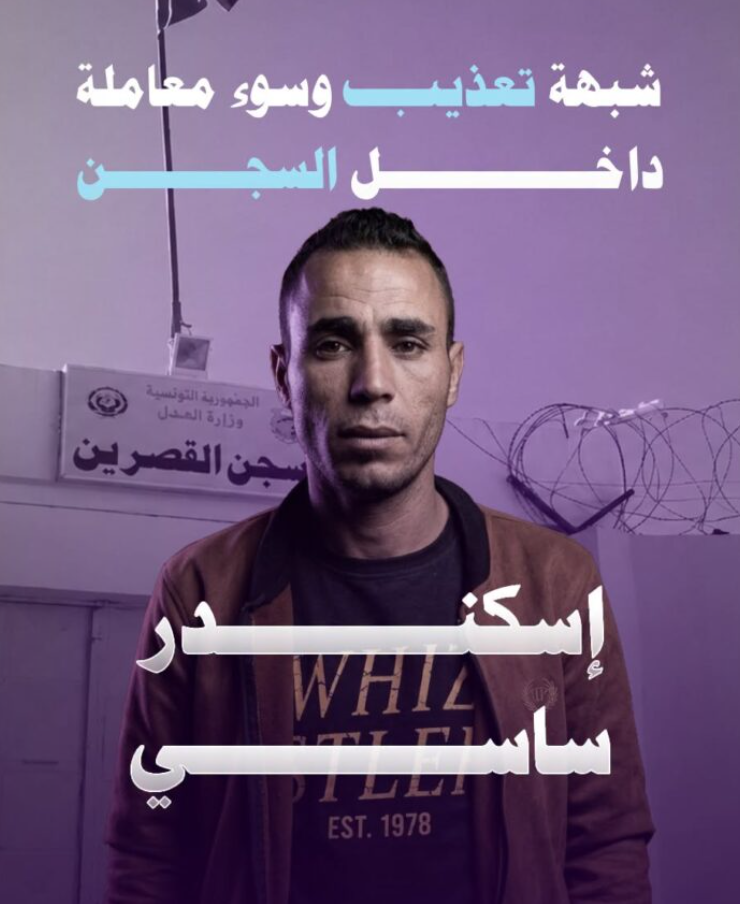
Skander Sassi
Summary
Intersection Association for Rights and Freedoms expresses its deep concern over suspected torture and ill-treatment suffered by citizen Skander Sassi, aged 33, while detained at Kasserine civil prison in connection with a criminal case.
The victim holds a disability card attesting to an intellectual disability and receives regular psychiatric follow-up; he has also previously been admitted to Razi University Hospital in Manouba on more than one occasion, which places him in a situation of vulnerability requiring special protection and care under national legislation and the relevant international standards.
The information documented by Intersection Association for Rights and Freedoms, based on the accounts of the victim's family, confirms that he was punished by being placed in solitary confinement (the "cellule") without any justification, and was then transferred to Sidi Bouzid civil prison without prior notice to the family. He was also prevented from appearing before the court at his first hearing on the pretext that the Sidi Bouzid prison's detainee transport vehicle had broken down.
The family further states that, during one of their visits, they observed clear signs of violence on Skander's body, raising serious suspicions that he was subjected to torture or other forms of ill-treatment during his detention. Following this, they filed a complaint with the sentence enforcement judge at the Kasserine Court of First Instance, who examined the initial information and ordered that Skander be brought in to investigate the facts and to examine and verify the signs of violence, and also authorised the opening of an investigation into the circumstances of the assault.
The victim's family states that Skander appeared before the court at the following hearing, where it was decided to release him. However, after his release, he was surprised to learn that a number of prison officers had filed a criminal complaint against him, accusing him of assault, threats and defamation while they were performing their duties.
Intersection Association for Rights and Freedoms considers that the documented facts, combined with the victim's fragile health and psychological condition, raise serious concerns about respect for his right to physical and psychological integrity and the safeguards owed to persons in detention, particularly persons with disabilities, for whom national laws and international standards require the provision of protection, care and reasonable accommodation appropriate to their situation.
Article 25 of the 2022 Constitution of the Tunisian Republic prohibits torture and all forms of cruel, inhuman or degrading treatment or punishment and guarantees bodily integrity and human dignity, while Article 36 provides for the right of every person deprived of their liberty to humane treatment that preserves their dignity, and Article 54 obliges the state to protect persons with disabilities and to take measures to guarantee their rights and inclusion.
Article 7 of the International Covenant on Civil and Political Rights also guarantees the prohibition of torture and other cruel, inhuman or degrading treatment or punishment, while Article 10 affirms that all persons deprived of their liberty must be treated with humanity and with respect for their inherent dignity. The Convention against Torture obliges the state to conduct a prompt and impartial investigation into every credible allegation of torture or ill-treatment, while the Convention on the Rights of Persons with Disabilities requires ensuring protection from violence and ill-treatment and providing reasonable accommodation and appropriate protection during detention.
Rule 45 of the United Nations Standard Minimum Rules for the Treatment of Prisoners (the Nelson Mandela Rules) also affirms that solitary confinement should remain an exceptional measure, and prohibits its use when, because of a mental or psychological disability, it would exacerbate the condition or suffering of the detained person.
In light of these facts, the Association considers that what Skander Sassi suffered requires a prompt, independent and effective investigation into the allegations of torture and ill-treatment and ensuring the accountability of anyone found to be involved, while providing the victim with all the necessary legal safeguards and taking into account his situation as a person with an intellectual disability in all relevant judicial and administrative proceedings.
Intersection Association for Rights and Freedoms calls on the Tunisian authorities to:
- Ensure an independent, effective and impartial investigation into all allegations of torture and ill-treatment suffered by Skander Sassi, publish its results and hold accountable anyone found to be involved, in accordance with the law.
- Ensure the victim's protection from any acts of reprisal, intimidation or pressure that may be linked to his exercise of his right to report violations or his cooperation with the judicial authorities.
- Ensure respect for the victim's procedural rights, taking into account his health and psychological condition and his intellectual disability, and provide the necessary reasonable accommodation and support at all stages of the proceedings.
- Ensure respect for the rights of all persons in detention, particularly persons with disabilities, in accordance with the Tunisian Constitution and Tunisia's international obligations, and take measures to prevent torture and ill-treatment in places of detention.
Inside Prison
Skander Sassi, a 31-year-old Tunisian citizen from the Kasserine region, holds a disability card and receives treatment at Razi Hospital. He was committed to Kasserine civil prison in connection with a criminal case, and was later transferred to Sidi Bouzid civil prison.
During one of his family's visits, they discovered that he had been punished by being placed in solitary confinement (the "cellule") without any explanation or justification for this measure.