
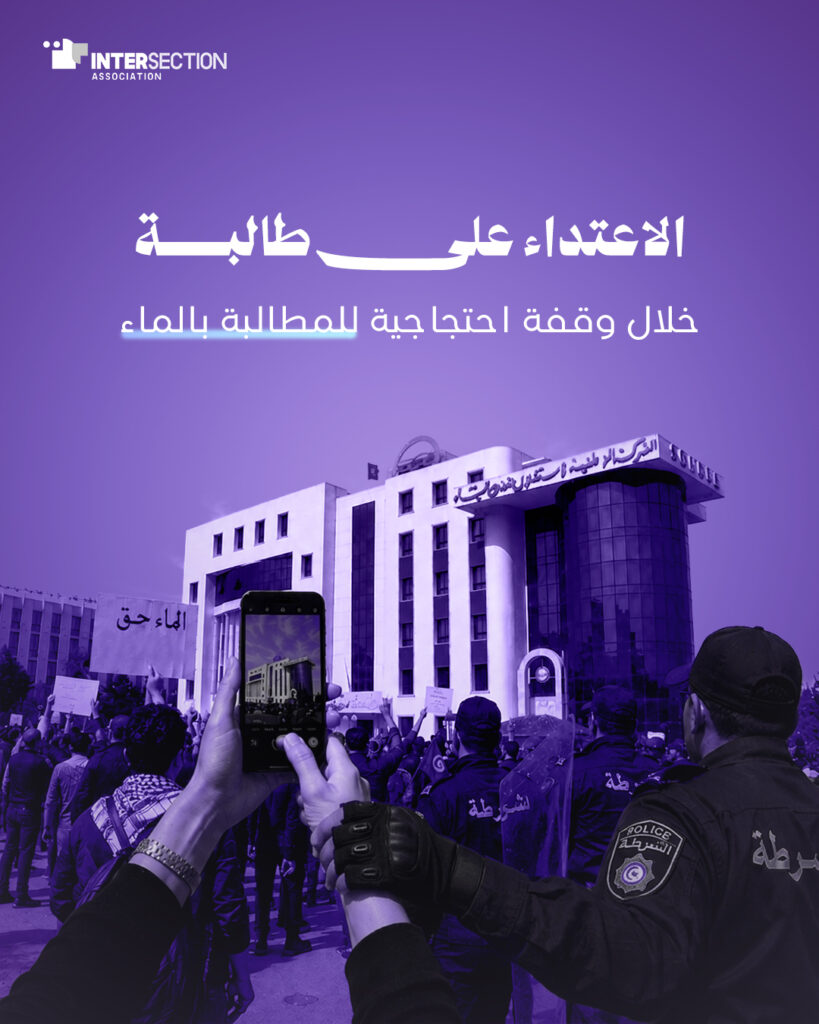
Sousse: Student Assaulted During a Protest Demanding Water
Summary
The governorate of Sousse experienced repeated, hours-long interruptions in the drinking water supply, prompting a group of citizens to hold a peaceful protest on 6 August 2026 in front of the headquarters of the National Water Distribution Utility (SONEDE), demanding an end to the cuts and solutions to the crisis.
While covering the protest, a student at the Faculty of Law and Political Science of Sousse was, according to her account, assaulted by two security officers while filming a speech by one of the participants. The assault consisted of preventing her from continuing to film, expelling her from the vicinity of the headquarters, pushing her and attempting to seize her phone by force, in addition to insulting her.
Personal Information
Status: Student at the Faculty of Law and Political Science of Sousse.
Nationality: Tunisian.
Governorate: Sousse.
Incidents of Violation
Following continued repeated, hours-long cuts to drinking water in the governorate of Sousse, a number of citizens called for a peaceful protest on 6 August 2026 at 10 a.m. in front of the headquarters of the National Water Distribution Utility, demanding an end to the water cuts and solutions to the crisis.
Around twenty citizens, aged between 21 and 60, took part in the protest. The action was limited to raising banners denouncing the continued water cuts and what the participants considered to be the disregard of their demands, with no acts of violence, vandalism or inflammatory slogans recorded.
During the protest, a student at the Faculty of Law and Political Science of Sousse was filming a speech by one of the participants. According to her account, two security officers moved towards the protest site, and one of them interrupted her filming, expelled her from the vicinity of the company's headquarters and prevented her from continuing to film.
The victim added that the officer pushed her and attempted to seize her mobile phone by force, and also insulted her, which prevented her from continuing to film the course of the protest.
Human Rights Violations
The documented facts point to suspected violations of a number of fundamental rights and freedoms, in particular freedom of expression and the right to seek, receive and impart information, as well as physical integrity and human dignity. The victim was filming a speech by one of the participants during a peaceful protest, before two security officers intervened to prevent her from continuing to film and expel her from the vicinity of the company's headquarters, and then pushed her, attempted to seize her mobile phone by force and insulted her. In light of the available information, these acts raise suspicions of unjustified interference with the victim's exercise of her right to expression and to document an event of public interest, particularly since there is no information indicating that she posed a threat to security or obstructed the work of the security officers.
Article 37 of the 2022 Constitution of the Tunisian Republic protects freedom of opinion, thought, expression, information and publication, and Article 38 guarantees the right to information and the right of access to information, while Article 19 of the International Covenant on Civil and Political Rights guarantees the right to seek, receive and impart information and ideas through any media. Documenting peaceful protests and gatherings is also linked to the exercise of these rights, particularly when it concerns an event of public interest.
The pushing of the victim and the attempt to seize her phone by force, together with the insults directed at her, also raise suspicions of an infringement of her physical integrity and dignity. Given that the intervention occurred, according to her account, in the context of a peaceful protest while the victim was filming, with no information indicating that she used violence or posed a danger, the use of force against her raises serious questions about respect for the principles of necessity and proportionality in the intervention of law enforcement officers. The actions of the internal security forces are governed by Law No. 70 of 1982, and international standards governing law enforcement require that force be used only when necessary and to an extent proportionate to the legitimate aim pursued.
As regards the right to peaceful assembly, the documented protest was peaceful, according to the available information, and no acts of violence or vandalism were recorded. Article 42 of the 2022 Constitution of the Tunisian Republic guarantees freedom of peaceful assembly and demonstration, and Article 21 of the International Covenant on Civil and Political Rights protects this right, as does Article 11 of the African Charter on Human and Peoples' Rights.
It should be noted that the protest came in response to repeated, hours-long cuts to the drinking water supply in the governorate of Sousse, which relates to the right to water guaranteed by Article 48 of the 2022 Constitution of the Tunisian Republic.