Summary:
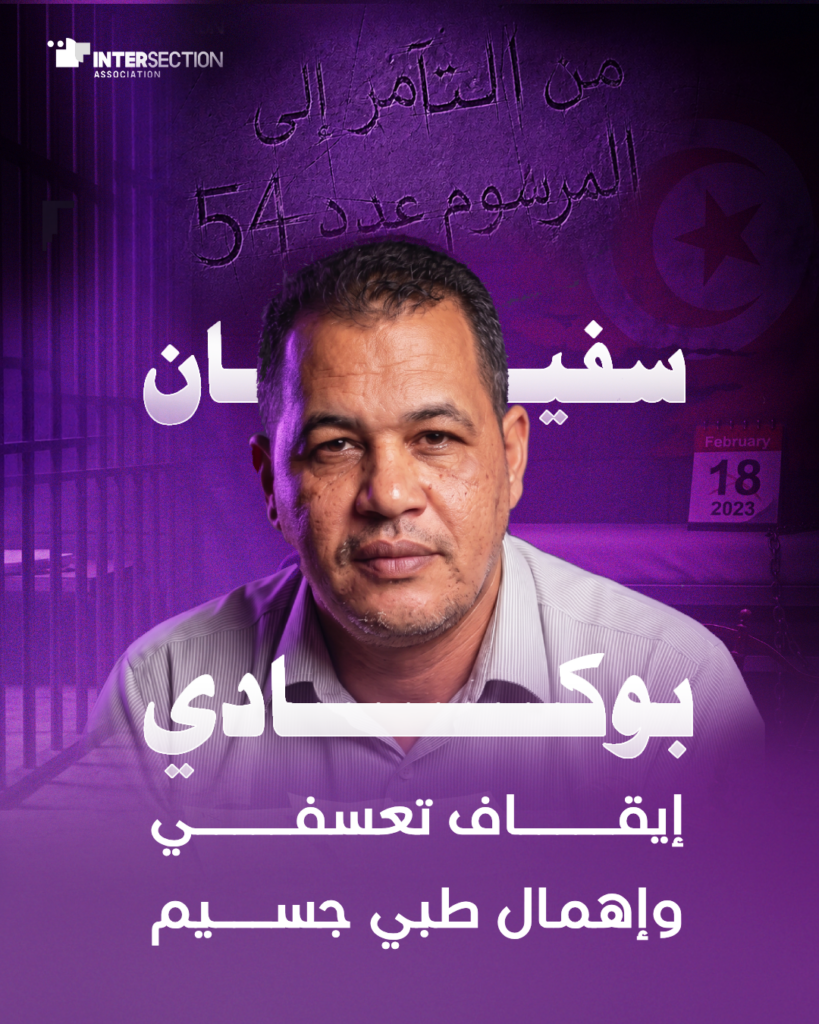
Sofiane Boukadi, a Tunisian human rights activist, was subjected to an arbitrary arrest on the date of 18 February 2026, with no prior judicial warrant, followed by detention and prolonged interrogation with no prior notification, amidst degrading conditions, for reasons believed to be politically motivated, according to his testimony.
Enduring medical neglect and ill-treatment throughout his detention and imprisonment, he suffered a serious deterioration in his health, including repeated heart attacks, temporary partial paralysis, and chronic illnesses. He was also denied essential medication and medical examinations despite medical recommendations.
He was denied his right to a defense and was deprived of bringing in an attorney, as he was subjected to pressure and threats in detention, which drove him to go on a hunger strike. It was also brought against him. A court ruling was issued against him, sentencing him to three years in prison and a financial fine of 30,000 dinars, on the charge of spreading false information under Article 24 of Decree No. 54.
Personal Information:
Name: Sofiene Boukadi
Age: 44 years
Nationality: Tunisian
Region: Nabeul
Occupation: Activist
Charges:
-Conspiracy against the internal and external security of the state, intended to change the form of the state.
-Spreading false information within the meaning of Article 24 of Decree-Law 54.
Methodology:
Intersection Association for Rights and Freedoms prepared this documentation paper based on a precise monitoring process of the facts related to the case of Sofiene Boukadi, through the collection, analysis, and organization of the available information, in a way that makes it possible to clearly and coherently construct the course of the violations.
The paper relied primarily on the victim’s account as contained in the case file, in addition to the available supporting documents related to the security and judicial procedures, as well as the file documenting his health condition during the period of custody and imprisonment. These facts were also analyzed in light of the national legal framework, particularly the provisions of
The 2022 Constitution and the relevant legislation, and compared with international and regional human rights standards, especially those related to the prohibition of arbitrary detention, guarantees of a fair trial, and the right to health and humane treatment.
This methodology aims to provide an objective human rights-based assessment that highlights the nature of the recorded violations and the extent to which they conflict with the state’s obligations.
Violation Incidents:
Sofiene Boukadi, a human rights activist, was arbitrarily arrested on 18 February 2023[1] by plainclothes police forces circulating in a normal vehicle without identifying or presenting themselves or presenting a judicial warrant. They confiscated his phone and escorted him to his family home, where his rereaétives live.
Police officers forcibly entered the home after breaking down the door and proceeded to conduct a search without presenting a clear warrant or publicly stated legal justification. According to the victim, the officers photographed him and mocked him without informing him of the nature of the accusations against him or the legal basis for the raid and search, constituting a serious violation of human dignity and of the legal safeguards guaranteed to him.
The search report also contained inaccurate information, as the officers claimed that the search had been conducted in the presence of his wife, even though the person concerned is not married. This raises serious concerns regarding the accuracy of the information recorded in the report and the integrity and legality of the procedures followed.
After that incident, he was taken to the specialized anti- terrorism unit in Laouina[2], where he was put into custody and interrogated for 14 successive hours, according to his testimony by several security officers. He further states that he had not been notified of the charges against him nor was he granted the rights protected to him by the law, including the right to the presence of a lawyer.
During the interrogation, Sofiene described the process as highly tiring, given the long questioning hours and circumstances, which he described as heinous. He also noted that most of the questions focused on his civic and associative activities, his political positions, and his relations with civil society organizations. He further stated that he was again filmed using a mobile phone without his consent or any explanation, and that he was subjected to mockery and humiliation from the moment of the house search through to his time in detention, particularly during a thorough body search.
On the second day of custody, 19 February 2023, the investigation continued with Sofiene being interrogated for more than 12 hours, according to his estimate. He emphasized that the questioning remained largely political in nature, while he was still not informed of the charges against him. As the interrogation and associated exhaustion continued, his health condition began to deteriorate progressively.[3]
Noticeable health symptoms developed, including high blood pressure and elevated sugar levels, according to his statement. Despite this, the interrogation continued, in clear disregard of the severity of his medical condition. It was later confirmed, according to the medical report, that he had suffered a heart attack.
On 20 February 2023, he was transferred to the Internal Security Forces Hospital in La Marsa after suffering a heart attack during the investigation. However, the officers requested that the doctor return him to the quarters of Laouina to continue the interrogation.
The investigation continued until 2 March 2023, when he was brought before the public prosecutor at the Judicial Counter Terrorism Division, which decided to refer the case to the Court of First Instance of Ben Arous.
On 3 March 2023, He was brought before the fourth investigating judge, where the victim stated that he had been treated in a degrading manner and that the issuance of medical reports was refused. A detention order was then issued against him, placing him in the civil prison of Mornaguia for one year on charges of conspiring against state security.
He also adds that he was deprived of his right to a defense, as his lawyer was prevented from representing him and was told that she herself was suspected of involvement in the case (her name reportedly appeared in the investigation file). On the same day, upon his admission to Mornaguia prison, he was placed in a cell known as a “disciplinary cell” despite his critical health condition, where he suffered a hemorrhage from the mouth and ear on March 4, 2023. However, he was not seen by a doctor to receive medical treatment.
After 11 days, he was transferred to Charles Nicolle Hospital on March 15, 2023, under heavy security. There, he was diagnosed with severe internal bleeding, and it was likely linked to a heart attack. He remained in the hospital until March 17, 2023, after which he was returned to prison before completing his treatment, despite the doctor’s objection. This led to a deterioration in his health.
He later suffered, at the beginning of August 2023, a temporary paralysis (hemiplegia), which required his transfer to the neurology department of Rabta Hospital.
During May, Sofiene suffered the loss of his brother. Despite his multiple attempts to attend, he was not allowed to attend the funeral held on May 17, 2023, which denied him fundamental human rights, including mourning his brother and participating in the burial and ceremonies.
On September 9, 2023, he suffered a health crisis that required his transfer to Charles Nicolle Hospital, where he stayed for one and a half months in the internal medicine department before being discharged on October 13, 2023. It was later revealed that he had suffered a second heart attack, likely resulting from medical negligence in prison. He was also diagnosed with heart failure and Behçet’s disease.
Following this, he was transferred to Aziza Othmana Hospital to undergo a medical procedure for sperm cryopreservation before starting treatment, in coordination with the internal medicine department of Charles Nicolle Hospital.[4]
He was visited by the Inspector General of the Ministry of Justice after he notified them of his intention to file a lawsuit regarding the serious health damage he had suffered. In this context, he stated that the inspector treated him in a manner that did not respect his human dignity, and that this was accompanied by an implicit threat, without consideration for his psychological and health condition.
He also confirmed that the prison administration did not provide him with the medication he was entitled to, nor did it allow his family to supply it to him. In addition, they refused to transfer him for medical treatment, despite the prison doctor’s acknowledgment that such a transfer was necessary.
He was also subjected to an act of aggression in which the papers he used to write down his notes and personal writings in prison were torn up, including documents in which he was recording his health condition and detention circumstances, which constituted a violation of his right to expression and to document his situation.
On November 6, 2023, he began a hunger strike that lasted 15 days in protest against being denied access to his medication, which consisted of 13 different types prescribed for the treatment of chronic illnesses, amid continued deprivation of medical care. This later led to permission being granted for him to receive his medication, but only sporadically and irregularly.
The hunger strike was also a protest against the refusal of the fourth investigating judge at the First Instance Court of Ben Arous to approve a petition allowing the extraction of medical reports documenting the deterioration of his health condition, according to Sofiene.
The doctor’s request to subject him to a scan (scintigraphy) was also refused by the prison medical unit, which prevented a complete and accurate medical diagnosis to assess his heart condition. It is believed that this was done to limit evidence of the consequences of the medical negligence he had suffered.
It is also worth noting that, in addition to the harassment and ill-treatment he was subjected to inside the prison, the transfers between the prison and the hospital were carried out in harsh and inhumane conditions.
On December 18, 2024, a first-Instance ruling was released by the Court of First Instance of Ben Arous, ruling that the case concerning Conspiracy against the security of the state was inadmissible. He was instead referred under Article 24 of Decree 54 in connection with the reposting of a publication that was classified as offensive to the President of the Republic[5]. He was subsequently sentenced to three years in prison and a fine of 30,000 dinars.
The ruling was appealed, and appellate judgment No. 43068 issued by the Tunis Court of Appeal on June 3, 2025 upheld the initial verdict.
On March 2, 2026, he was released from prison after serving 3 years and 14 days, exceeding the legal sentence due to the failure to take into account the period of pre-trial detention.
Human Rights Violations:
All the facts above constitute a series of serious and multiple human rights violations, as what Sofiene Bouakdi was subjected to represents a blatant violation of fundamental rights guaranteed by both national and international laws. His arrest and escort to his house, photographing him in a state of breakdown, and taking him to interrogation into custody for investigation, and denied the ability to contact a lawyer, without being informed of the reasons for his arrest or the nature of the suspicion against him. This constitutes a clear violation of the arrest procedures set out in Article 13 of the Code of Criminal Procedure, which requires that a suspect be immediately informed of their rights, including the right to contact a lawyer and a family member, as well as the right to a medical examination during detention.
It also represents a breach of the guarantees of detainees’ rights provided for under Law No. 5 of 2016. This also constitutes a violation of Article 23 of the 2022 Constitution, which stipulates that the state guarantees the protection of human dignity and the inviolability of the body, and prohibits all forms of physical and psychological torture, noting that the crime of torture is not subject to statutory limitations. It also breaches Article 7 of the International Covenant on Civil and Political Rights, which prohibits subjecting any person to torture or to cruel, inhuman, or degrading treatment or punishment.
The victim’s being taken to his residence, the forced entry into his home, and the breaking of the door constitute a violation of the inviolability of the home and private life, as guaranteed by Article 17 of the International Covenant on Civil and Political Rights, which prohibits any arbitrary or unlawful interference with a person’s privacy, family, home, or correspondence. This also constitutes a breach of Article 30 of the 2022 Constitution.
Interrogating the victim for long hours without the presence of legal safeguards constitutes a violation of the right to a fair trial guaranteed by Article 35 of the 2022 Constitution, which stipulates that no person may be arrested or detained except in cases of flagrante delicto or by judicial order, and that they must be immediately informed of their rights and the charges against them, as well as their right to legal representation by a lawyer.
It also breaches Article 14 of the International Covenant of Civil and Political Rights and Article 7 of the African Charter on Human and Peoples’ Rights.
The treatment Sofiene Boukadi was subjected to during his custody and imprisonment, which was characterized by degrading treatment, psychological pressure, and methods that undermine human dignity, clearly falls within the legal classification of cruel, inhuman, and degrading treatment.
This classification is based on Article 16 of the Convention Against Torture, which obliges states to prevent any acts amounting to cruel, inhuman, or degrading treatment, and on Article 5 of the African Charter on Human and Peoples’ Rights, which guarantees respect for human dignity and prohibits all forms of exploitation and humiliation. The 2022 Constitution also enshrines this protection in Article 23, imposing a positive obligation on authorities not to subject any person to degrading treatment, particularly in the context of detention or imprisonment. These guarantees were violated through prolonged interrogations under pressure, verbal humiliation, and the deliberate disregard of the victim’s psychological and medical condition.
On the other hand, the deterioration of the victim’s health condition without providing him with the necessary medical care, despite the emergence of serious symptoms, constitutes a clear violation of the right to health, as enshrined in Article 12 of the International Covenant on Economic, Social and Cultural Rights, which guarantees every person the right to enjoy the highest attainable standard of health, as well as Article 16 of the African Charter on Human and Peoples’ Rights, and Article 38 of the 2022 Constitution, which stipulates that health is a right for every human being and that the State is obliged to ensure healthcare. Accordingly, the failure to provide the victim with treatment despite his critical condition constitutes a serious breach of this obligation and amounts to inhuman treatment, given the grave risks it has caused to his physical integrity.
Moreover, depriving him of completing his treatment and returning him to prison without medical consent constitutes serious and deliberate medical negligence, which falls within cruel and inhuman treatment, in violation of the State’s obligations under the Convention against Torture and the African Charter, as well as Article 38 of the Constitution, which requires the provision of full medical care and prohibits exposing the patient to health risks.
The prison administration’s prevention of him from receiving essential chronic medication constitutes a violation of his right to humane treatment guaranteed under Article 36 of the Constitution, which stipulates that every prisoner has the right to treatment that preserves their dignity. It also represents a breach of his right to healthcare during detention under the United Nations Standard Minimum Rules for the Treatment of Prisoners (the Nelson Mandela Rules), particularly Rules 24 to 26, which guarantee every prisoner adequate and comprehensive healthcare.
As well as depriving him from undergoing medical procedures, especially after his health deterioration reflects the medical neglect and shows a serious failure to protect prisoners’ health.
On the other hand, his prosecution under Article 24 of Decree 54 and his retrial over a social media post he shared seriously violate his right to freedom of expression and a fair trial, especially since the sentence of 3 years and 14 days in prison and a fine of 30,000 dinars seems too harsh compared to the act he is accused of. This constitutes a violation of freedom of expression and opinion protected by Article 19 of the Universal Declaration of Human Rights, Article 19 of the International Covenant on Civil and Political Rights, and Article 9 of the African Charter on Human and Peoples’ Rights, which guarantee freedom of expression with no restrictions.
Based on these incidents mentioned above, this case reveals a series of systematic violations inflicted on the victim, including arbitrary arrest, infractions of fair trial guarantees, inhuman treatment, and serious medical neglect, which resulted in severe health complications, putting his life at risk. These occurrences are a series of serious and multiple human rights violations, as what the victim was subjected to represents a serious breach of fundamental rights guaranteed by national and international law. His arrest, taking him to his home, filming the house and the victim in a state of distress, then taking him for a search, and preventing him from contacting a lawyer without informing him of the reasons for his arrest or the nature of the suspicion against him, all constitute a violation of the arrest procedures set out in Article 13 of the Code of Criminal Procedure, which requires that a suspect be immediately informed of their rights, including the right to contact a lawyer and a family member, and the right to a medical examination during detention.
What happened also constitutes a breach of Article 23 of the 2022 Constitution, which states that “The State shall protect human dignity and the inviolability of the human body, and shall prohibit both physical and moral (psychological) torture. The crime of torture shall not be subject to any statute of limitations”. As well as article 7 of the International Covenant on Political and Civil Rights that states that “No one shall be subjected to torture or to cruel, inhuman or degrading treatment or punishment”.
Also barging into the house of the victim of violation and breaking the door, a violation of the inviolability of the home and the right to privacy, safeguarded by Article 17 of the International Covenant on Civil and Political Rights which states that “No one shall be subjected to arbitrary or unlawful interference with his privacy, family, home or correspondence, nor to unlawful attacks on his honour and reputation.” and of Article 30 of the 2022 Tunisian Constitution.
Interrogating the victim of a violation for long hours with no access to legal protections and the assistance of counsel constitutes a violation of the right to a fair trial. This right is guaranteed by Article 35 of the 2022 Constitution, which protects individuals against arbitrary arrest and detention and ensures their right to be informed of the charges against them and to legal representation. It also violates the fair trial guarantees enshrined in Article 14 of the International Covenant on Civil and Political Rights and Article 7 of the African Charter on Human and Peoples’ Rights.
During his arrest and during his detention, the victim of violation was subjected to heinous treatment and psychological pressure, and the use of measures that contradict human dignity, which clearly falls within the legal characterization of cruel, inhuman, and degrading treatment. This legal characterization is grounded first and foremost in international law. Article 16 of the Convention against Torture obliges States Parties to prevent acts constituting cruel, inhuman, or degrading treatment or punishment that do not amount to torture, when such acts are committed by, at the instigation of, with the consent of, or with the acquiescence of public officials. This framework is reinforced at the regional level by Article 5 of the African Charter on Human and Peoples’ Rights, which states that “Every individual shall have the right to the respect of the dignity inherent in a human being and to the recognition of his legal status. All forms of exploitation and degradation of man, particularly slavery, slave trade, torture, cruel, inhuman or degrading punishment and treatment, shall be prohibited.”
At the national level, the 2022 Tunisian Constitution safeguards this. In fact, Article 23 states that “the State shall protect human dignity and the inviolability of the human body, prohibit physical and psychological torture, and ensure that the crime of torture is not subject to any statute of limitations.” This provision imposes a positive obligation on public authorities to refrain from subjecting any person to degrading or dignity-undermining treatment, particularly in the context of detention or imprisonment. Accordingly, the acts consisting of prolonged interrogation under pressure, verbal abuse, and the deliberate disregard of the victim’s psychological and physical condition constitute a clear violation of these constitutional guarantees. Such conduct amounts to inhuman and degrading treatment and gives rise to legal accountability.
The deterioration of the victim’s health condition, coupled with the failure to provide the necessary medical care despite the appearance of serious symptoms, constitutes a clear violation of the right to health as recognized under various legal frameworks. At the international level, Article 12 of the International Covenant on Economic, Social and Cultural Rights recognizes “the right of everyone to the enjoyment of the highest attainable standard of physical and mental health” and requires States to take the necessary measures to ensure access to medical treatment and healthcare for all persons in need, particularly in emergency situations.
This protection is further reinforced at the regional level by Article 16 of the African Charter on Human and Peoples’ Rights, which provides that every individual has the right to enjoy the best attainable state of physical and mental health and that States must take the necessary measures to protect the health of their populations and ensure access to medical care in cases of illness.
On the national level, the 2022 Tunisian Constitution protects this right through Article 38 which states that Health is a right for every human being. The State shall guarantee prevention and healthcare for all citizens and provide the necessary resources to ensure the quality of health services.” This establishes a direct obligation on the State to ensure immediate and appropriate medical treatment, particularly for persons deprived of their liberty.
Accordingly, the failure to provide the victim with medical care despite his critical health condition constitutes a serious breach of this obligation and a clear violation of the right to health. It also amounts to a form of inhuman treatment, given the serious risks it poses to the victim’s physical integrity.
The facts indicate that the victim was denied the completion of his medical treatment and returned to prison without medical approval, which constitutes serious and deliberate medical negligence amounting to cruel and inhuman treatment.
At the international level, Article 16 of the Convention against Torture requires States to prevent any acts of cruel, inhuman, or degrading treatment or punishment, which includes the disregard of a detainee’s medical condition. Similarly, Article 16 of the African Charter on Human and Peoples’ Rights guarantees every individual the right to enjoy the best attainable state of health and access to medical care.
At the national level, Article 38 of the Constitution provides that health is a right for every human being and that the State shall guarantee prevention and healthcare services. This imposes an obligation to ensure full medical treatment and to avoid exposing patients to health risks. Accordingly, returning the victim to prison under such circumstances constitutes a clear violation of these guarantees.
The prison administration’s denial of the victim’s access to essential and chronic medication constitutes a violation of his right to humane treatment, as guaranteed by Article 36 of the Constitution, which states that: “Every prisoner has the right to humane treatment that preserves his dignity.” This principle was breached in the present case, in addition to the victim being prevented from undergoing medical examinations after suffering a second heart attack, which occurred as a result of medical negligence following the first cardiac episode during the investigation.
The failure to provide the victim with necessary medication constitutes a violation of his right to healthcare during detention, a right guaranteed under international law by the United Nations Standard Minimum Rules for the Treatment of Prisoners (the Nelson Mandela Rules), in particular Rules 24 to 26, which affirm that every prisoner has the right to adequate and comprehensive healthcare.
Referring the case under Article 24 of Decree-Law 54, despite the absence of the alleged offence, and retrying the victim for a post he shared on his personal social media account, constitutes a serious violation of his right to freedom of expression and fair trial guarantees.
Moreover, the prosecution of the victim and the deprivation of his liberty for 3 years and 14 days, in contrast with a fine of 30,000 dinars for sharing a social media post, raises concerns of disproportion between the alleged conduct and the custodial sentence imposed, potentially affecting the core of rights guaranteed at the international, regional, and national levels.
The right to freedom of opinion and expression is a fundamental right protected under international, regional, and domestic legal frameworks. Article 19 of the Universal Declaration of Human Rights states that: “Everyone has the right to freedom of opinion and expression; this right includes freedom to hold opinions without interference and to seek, receive and impart information and ideas through any media and regardless of frontiers.” This right is further enshrined in Article 19 of the International Covenant on Civil and Political Rights in binding terms. At the regional level, Article 9 of the African Charter on Human and Peoples’ Rights affirms the right of every individual to receive information and express and disseminate their opinions, imposing on States an obligation to protect this right from arbitrary or disproportionate restrictions.
These events reflect an interconnected series of violations affecting the human rights defender Sofiane Boukad, encompassing arbitrary detention, violations of fair trial guarantees, ill-treatment, and severe medical negligence that resulted in serious health consequences, potentially placing his life at risk.
[1] Lemaghreb, The arrest of activist Sofiene Boukadi, 18 February 2023.https://ar.lemaghreb.tn/%D9%82%D8%B6%D8%A7%D8%A1/item/67815-%D8%A5%D9%8A%D9%82%D8%A7%D9%81-%D8%A7%D9%84%D9%86%D8%A7%D8%B4%D8%B7-%D8%A7%D9%84%D9%85%D8%AF%D9%86%D9%8A-%D8%B3%D9%81%D9%8A%D8%A7%D9%86-%D8%A8%D9%88%D9%83%D8%A7%D8%AF%D9%8A?tmpl=component&print=1 ،Date consulted: 14 April 2026.
[2] Lemaghreb, After his arrest at the end of last week: questioning of Sofiene Boukadhi at the El Aouina barracks. 21/02/2023
https://ar.lemaghreb.tn/%D9%82%D8%B6%D8%A7%D8%A1/item/67815-%D8%A5%D9%8A%D9%82%D8%A7%D9%81-%D8%A7%D9%84%D9%86%D8%A7%D8%B4%D8%B7-%D8%A7%D9%84%D9%85%D8%AF%D9%86%D9%8A-%D8%B3%D9%81%D9%8A%D8%A7%D9%86-%D8%A8%D9%88%D9%83%D8%A7%D8%AF%D9%8A?tmpl=component&print=1 , Date consulted: 14 April 2026.
[3] Mosaique, Sofiene Boukadi’s lawyer: Questioning of my client without knowledge of the charges, 21/02/2023, https://www.mosaiquefm.net/ar/%D8%AA%D9%88%D9%86%D8%B3-%D9%88%D8%B7%D9%86%D9%8A%D8%A9/1137719/%D9%85%D8%AD%D8%A7%D9%85%D9%8A%D8%A9-%D8%B3%D9%81%D9%8A%D8%A7%D9%86-%D8%A8%D9%88%D9%83%D8%A7%D8%AF%D9%8A-%D8%A7%D9%84%D9%8A%D9%88%D9%85-%D8%A7%D9%84%D8%A 5%D8%B3%D8%AA%D9%85%D8%A7%D8%B9-%D9%84%D9%85%D9%86%D9%88-%D8%A8%D9%8A-%D8%AF%D9%88%D9%86-%D9%85%D8%B9%D8%B1%D9%81%D8%A9-%D8%A7%D9%84%D8%AA%D9%87%D9%85%D8%A9, Date consulted 14 April 2026.
[4] According to the medical report.
[5] Assabahnews, 23/10/2023, https://www.assabahnews.tn/ar/%D8%A7%D9%84%D8%A7%D8%AE%D8%A8%D8%A7%D8%B1/%D9%85%D8%AC%D8%AA%D9%85%D8%B9/74664-%D9%85%D9%88%D9%82%D9%88%D9%81-%D9%85%D9%86-%D8%A3%D8%AC%D9%84-%D9%82%D8%B6%D9%8A%D8%A9-%D8%A7%D9%84%D8%AA%D8%A2%D9%85%D8%B1-%D9%88%D8%A7%D9%84%D8%AA%D8%AE%D8%A7%D8%A8%D8%B1-%D9%85%D8%B9-%D8%AC%D9%87%D8%A7%D8%AA-%D8%A3%D8%AC%D9%86%D8%A8%D9%8A%D8%A9-%D8%A2%D8%AE%D8%B1-%D9%85%D8%B3%D8%AA%D8%AC%D8%AF%D8%A7%D8%AA-%D9%85%D9%84%D9%81-%D8%A7%D9%84%D9%86%D8%A7%D8%B4%D8%B7-%D8%B3%D9%81%D9%8A%D8%A7%D9%86-%D8%A8%D9%88%D9%83%D8%A7%D8%AF%D9%8A-%D9%8A%D9%83%D8%B4%D9%81%D9%87%D8%A7-%D9%85%D8%AD%D8%A7%D9%85%D9%8A%D9%87