
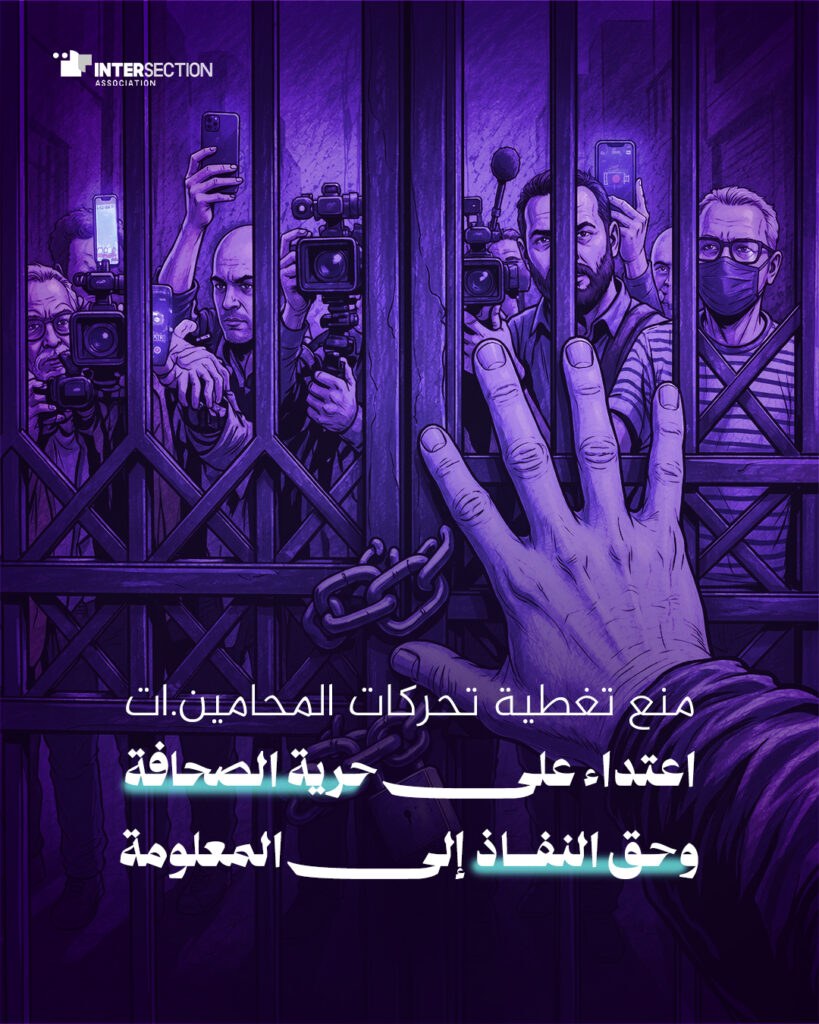
Journalists Barred from Covering the Lawyers’ Strike: An Attack on Press Freedom and the Right of Access to Information
Summary
On 18 June 2026, a number of journalists and press photographers were prevented from covering the general strike held by lawyers at the Court of First Instance in Bab Bnet. The violation consisted of preventing press teams from entering the court premises and providing on-the-ground coverage of the action, which constituted a direct obstruction of journalistic work and an infringement of the right of access to information.
This ban comes in a context in which the same pattern of violations against journalists covering similar actions keeps recurring, revealing successive restrictions on press freedom.
Incidents of Violation
On 18 June 2026, coinciding with the general strike held by a number of lawyers at the Court of First Instance in Bab Bnet, a number of journalists and press photographers were recorded as having been prevented from covering the action inside the court premises, which prevented them from directly following on the ground the course of the protest and the demands of its participants.
This development comes in a context marked by the recurrence of the same violations against journalists covering similar actions: on 19 May 2026, the Tunisian National Bar Association held a regional strike covering the courts of Greater Tunis (Tunis, Ariana, Ben Arous, Manouba) as well as the governorates of Nabeul and Zaghouan, during which a protest was held in the hall of the Palace of Justice.
The ban affected the various press teams that went to the scene to provide media coverage; they were prevented from entering the court and from carrying out their professional duties inside the court premises, despite the public nature of the action and its connection to matters of public interest relating to fair trial guarantees and the rights of the defence.
In this context, Jihen Louati, a member of the executive bureau of the National Syndicate of Tunisian Journalists, stated that what was recorded was not an isolated incident, but part of an ongoing pattern of obstacles and violations faced by journalists when trying to provide on-the-ground coverage inside judicial premises and their surroundings.
She also pointed out that a number of journalists had previously been prevented on earlier occasions from attending hearings and activities connected to professional bodies and actions inside the Palace of Justice in Tunis, which has created recurring difficulties in accessing information and following events related to judicial affairs.
She added that these practices undermine the right of journalists to carry out their professional duties, especially since press accreditation cards entitle them to cover hearings and public activities inside courts and judicial institutions, as they are an essential link in conveying information to the public.
She further considered that banning on-the-ground coverage deprives journalists of their role in reporting and explaining events, and directly affects citizens' right to follow what happens within the justice system and to access information from its direct sources.
These events are part of a broader context of restrictions on journalistic work in certain public and judicial spaces, particularly regarding access to the scene of events and the provision of appropriate conditions for on-the-ground coverage, which has a negative impact on the media's ability to provide comprehensive and balanced coverage of events of public interest.
Human Rights Violations
Preventing journalists from carrying out on-the-ground coverage inside judicial spaces undermines their right to freedom of journalistic work and to practise their profession independently, and also has a negative impact on citizens' right of access to accurate, direct and multi-sourced information. Restricting on-the-ground coverage, particularly of events of a public nature, constitutes a limitation on the essential role played by the press in reporting events and following public affairs.
Preventing access to the scene of events and reducing the possibilities for on-the-ground coverage also undermines the function of the press as a means of reporting events, monitoring the performance of public institutions and ensuring the circulation of information of public interest. Preventing journalists from covering actions and activities related to judicial affairs undermines the principle of openness of public space and society's right to follow what happens within the justice system, as a public service subject to the principles of transparency, accountability and public oversight.
Moreover, press coverage of judicial affairs is not a privilege granted to journalists; rather, it is one of the essential guarantees for strengthening trust between society and judicial institutions, and a fundamental mechanism for conveying facts and information in an objective and balanced manner.
At the national level, these practices contravene the provisions of the 2022 Constitution of the Tunisian Republic, which enshrines in its Article 37 freedom of opinion, thought, expression, information and publication, while Article 38 guarantees the right to information and the right of access to information. These constitutional guarantees affirm that press freedom is not merely an individual right of journalists, but a collective right linked to society's right to know and to access information on public affairs.
These restrictions also contravene the provisions of Decree-Law No. 115 of 2011 on freedom of the press, printing and publishing, which provides for the protection of journalists from all forms of pressure or obstruction that prevent them from carrying out their professional duties. In addition, Organic Law No. 22 of 2016 on the right of access to information enshrines the principle of transparency within public services and obliges public bodies to facilitate access to information of public interest and not to impose unjustified restrictions on its circulation.
At the international level, these practices contravene Article 19 of the Universal Declaration of Human Rights and Article 19 of the International Covenant on Civil and Political Rights, which guarantee the right to freedom of expression, including the freedom to seek, receive and impart information and ideas without interference. They also contravene the provisions of the African Charter on Human and Peoples' Rights, which affirms the need to protect freedom of expression and press freedom and to prevent any arbitrary restrictions that obstruct the work of the media or limit its watchdog role.
The relevant international standards on media freedom affirm that any restrictions imposed on journalistic work must be exceptional, prescribed by law, necessary and proportionate to the legitimate aim pursued. These conditions are not met in the recorded cases of bans and restrictions, particularly when it comes to covering events of a public nature in public and judicial spaces.
Accordingly, the recorded ban on on-the-ground coverage and the restrictions on the work of journalists inside judicial spaces constitute a disproportionate interference with the freedom and independence of journalistic work, and raise serious issues regarding respect for the role of professional media in guaranteeing citizens' right of access to information and to follow public affairs freely, pluralistically and transparently, without any unjustified direction or restriction.